
Trade wars are EV wars
Trade wars and EV tech transfer in the Americas
By Kate Mackenzie, Tim Sahay —
Canada's Mark Carney made a dramatic declaration of trade war with the U.S. over the weekend, walking away from talks that had apparently been close to finalized.
The Canadians said U.S. demands included an effective veto power over trade agreements with other countries; dismantling the Canadian dairy supply-management system; no reduction in US tariffs on heavier trucks; and removing French language requirements and local content rules for media.
The domestic politics of the Canadian response are important for understanding the implications for other countries. Carney's speech drew widespread domestic support from across the political spectrum. He is betting he has enough public support to withstand the pain the US is inflicting: 50% tariffs on many Canadian exports to its biggest market. Although the tariffs are concentrated in particular categories of Canadian exports, they could still be damaging. One academic estimates that although they’d only raise total aggregate tariffs on all exports by 2.5%, they would cost the country 90,000 jobs. An aid package for affected businesses that may last until the end of Trump's term is reportedly being planned.
Public opinion in Canada is broadly supportive of a strong stand on the US, but critical industrial and regional constituencies still have to be mollified. Earlier this year, after the Davos speech, we pointed out that Carney’s government had, since it came to power almost a year earlier, been scoping out alternatives to the U.S. market for various industries: brokering agricultural tariff-reduction deals with China; courting Chinese EV companies for investment after the partial U.S. repeal of the IRA caused write-offs across Canada’s auto industry; and becoming a full partner of Europe’s SAFE defense spending initiative so Canadian companies will be eligible suppliers for a €150 billion scheme.
None of this would be fast enough or big enough to replace the entire Canada-U.S. trade relationship, which is not just big but deeply integrated across supply chains – especially automotive:
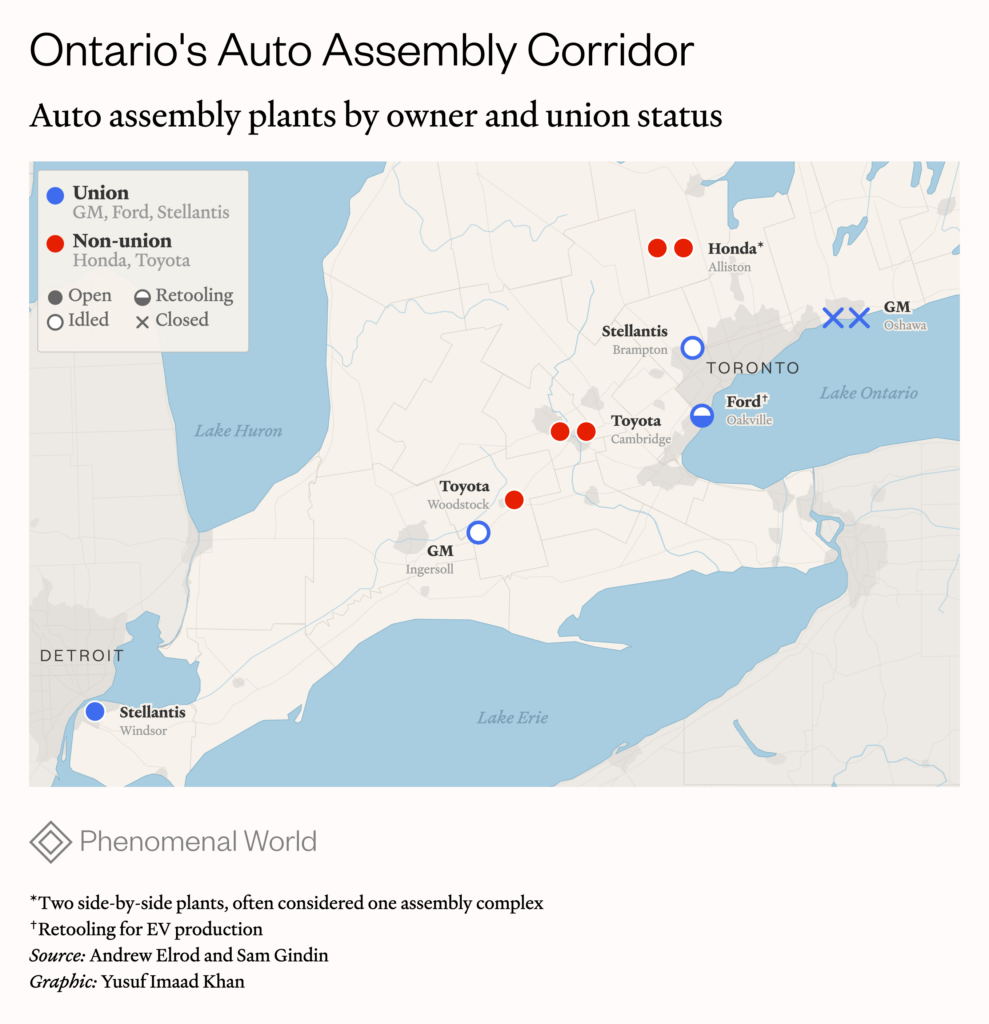
Remaining entangled with the US automotive brings another hazard: locking Canada's car companies into a determinedly gas guzzling focus while the rest of the world embraces electric vehicles.
Carney's government was hedging in both directions. Bloomberg News reported that despite the tough rhetoric at Davos:
"... Carney has in reality spent much of his time in office until now trying a conciliatory approach with the US, while diversifying Canada’s economy. He rolled back retaliatory tariffs applied by his predecessor Justin Trudeau, axed a digital services tax that irked Trump, and re-cut a deal in the US’s favor to open a bridge connecting Detroit to Windsor, Ontario."
The details of exactly what the U.S. demanded and what Canada considered beyond the pale are difficult to ascertain. The U.S. Trade Representative Jamieson Greer gave an interview to The New York Times last week declaring that the U.S. was actually going to give Canada a great deal on tariffs. As Rachel Ziemba points out, important details are often left to be negotiated at the last minute, under high pressure.
Whatever the threat to export markets, the US demands clearly became too politically sensitive for Carney to risk. From the Guardian:
"But as details of the agreement began to leak to Canadian media, there was growing alarm that Carney and his negotiators were conceding too much in exchange for lower tariffs on steel, aluminium and cars.
"The premier of Manitoba, Wab Kinew, and his Nova Scotia counterpart, Tim Houston, confirmed this week that Carney had asked the provinces to return US alcohol to shelves in order to seal the trade deal.
"Kinew told reporters he believed Canada “should fight” Trump instead, and that “you can’t get a good deal with a bad person”. He encouraged Canadians to avoid buying US alcohol, even if the premiers agreed to put it back on shelves."
Over the weekend, Carney even subtly threatened to use Canada’s energy weapon against the U.S.:
Carney: US’s narrow merchandise trade deficit only exists because US buys so much of its energy from Canada Can fuels US growth, supplying 99% of their natural gas imports, 85% of their electricity imports,60% of their crude oil imports I don’t think they want us to stop sending any of that energy
— Albert Pinto (@70sbachchan.bsky.social) 23 August 2026 at 02:38
[image or embed]
Just a couple of weeks ago, he'd rejected calls to use energy as a bargaining chip, citing the importance of being a reliable supplier.
Until now, China had been the only country to forcefully retaliate against the US tariff war with its rare earth counterweapon, which was largely successful in getting a backdown on tariffs. And, as Alan Beattie wrote last week, the US has largely failed in efforts to build up its own alternative rare-earth supply chains. The U.S. has been strategic, Ziemba says, by applying the 50% tariffs mostly to items that can be imported from elsewhere. But how Canada retaliates won't be revealed until September 8.
The outcome will probably be taken as a broad lesson for other middle powers dealing with the US. But countries watching how Canada fares will have to closely consider the domestic politics of both countries, not just the specifics of their trade relationships.
Chinese EV tech transfer
Chinese companies have been doing a lot of foreign direct investment over the past few years; particularly building EV, battery and other clean energy tech facilities. Host countries often negotiate for local jobs; and it's easy to ascertain how successful they are – but how much of the technology and process knowhow are they able to obtain?
A new paper from the TIDE centre at Oxford University looks at “bargaining chips” and green industrialisation in developing countries. The authors set out a kind of framework – drawing on the database of Chinese green FDI from the Net Zero Industrial Policy Lab (i.e., Tim’s group at Johns Hopkins) – but then they hone in on the case study of the BYD factory in Bahia, Brazil.
The plant, which used to be a Ford facility, was where our podcast opened. The TIDE authors conclude the Bahia project can’t be easily categorized as either “spillover success” or “extractive enclave.”
It *did* involve significant technical collaboration: the co-development of a flex-fuel plug-in hybrid powertrain adapted specifically to the Brazilian energy context – Brazil has long had an automotive market where cars can switch between pure ethanol, produced from the country's sugarcane crops, and gasoline blended with some ethanol.
The authors write that Brazil’s "flex-fuel" car market in itself became a bargaining chip; the market is big enough to make adapting to it worthwhile, and doing so required local engineering expertise, which meant "capability formation and bargaining power reinforced one another."
However, this is far from a guaranteed story of tech transfer success:
“Workers and engineers who acquire EV-specific capabilities, such as battery management systems, electric drivetrain diagnostics, and charging infrastructure, could in principle transfer these skills to Brazilian-owned firms, startups, or supplier networks, thereby activating a labour mobility spillover. Such dynamics, however, remain prospective. Given how recently the plant was established, more time is needed to observe whether and how labour transitions materialise.
“Nonetheless, the limits of Brazil’s policy leverage are also visible. BYD retains proprietary control over its battery chemistry, its blade battery technology, and its core software systems, none of which appear subject to explicit transfer requirements [from an interview]. The joint engineering on the flex-fuel engine is thus an example of localised adaptation rather than fundamental technology transfer: it remains within parameters set by BYD, rather than driven by Brazilian regulatory demands.”
LINKS: Extreme heat and adaptation


 advait