
Programming notes
Bond yields, energy subsidies and catastrophes -- and AI
By Kate Mackenzie, Tim Sahay —
Hi readers,
We're back after a break for podcast development (more on that below). A few updates from us:
We're doing an audience survey: We have the chance to expand The Polycrisis over the coming months and would rather ask than guess. There are 13 quick questions, it'll take about three minutes, and it's anonymous – unless you choose to leave your email at the end.
NY Climate Week: Last week Tim appeared on a live panel with The Break Down and Phenomenal World for the launch of The Break-Down’s new edition, #4 CHINA, which is excellent – go and read it, buy the hard copy, check out Jeremy Wallace's Ordosmaxxing, Kaiser Kuo & David Fishman's The Machine. The podcast recording will be available soon
Also at NYCW, Tim's Net Zero Industrial Policy Lab at JHU launched their new global database of every foreign-owned cleantech factory in the 21st century. There's a paper describing it all. Some striking findings: cleantech manufacturing FDI as a share of overall FDI has leapt from 2% to 20% of global FDI between 2017 and 2025. China has leapt to become the largest factory builder overseas, and the United States, perhaps surprisingly, has become the largest destination for foreign-owned cleantech factories.
In this edition: Energy subsidies are persisting as high oil prices are the new normal; which is adding to the pain of both emissions and borrowing costs. Discourse about AI has reached some new level of intensity, probably warranted – but how exactly? Also, a little about our latest PW essay on the Himalayas catastrophe and public adaptation, Disaster and Constraint.
Finally: We've made an Instagram account. Turns out there is a lot of political economy type content on there; who knew? It's early days for us there, however; visit our Discord if you want more action.
— Kate & Tim
The energy crisis that never ends
Faced with the now-unavoidable reality that oil and LNG will continue to be squeezed by the effects of the US and Israel's attacks on Iran, quite a few governments are advancing their decarbonization efforts – especially South-East Asian countries that are heavily reliant on Gulf imports, where actual gas-fired power plants are being cancelled, and renewables targets are being scaled up. And we made a whole podcast season about how households and businesses are enacting their own energy transition by taking advantage of China’s clean-tech manufacturing machine. EV use is accelerating in China. Actual oil consumption keeps falling short of IEA outlooks and the Strait of Hormuz closure is making some oil analysts lose any sense of conviction.
However, a lot of governments are also introducing or extending consumption-side subsidies for fossil fuels, or cutting fuel taxes, to protect constituents from the pain of higher prices. Data from the International Energy Agency (via an FT analysis) shows the number of countries doing so has increased greatly:
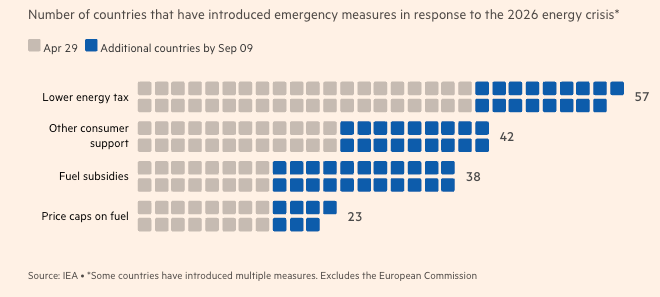
Of course, this is partly a time horizon problem. Many of the measures that will actually address the problem by cutting reliance on fossil fuels are just slower to pay off than the simple moves of subsidies and tax cuts. Subsidizing fossil fuels during an energy supply shock is simply bad policy from an orthodox economics perspective; you don't want to encourage consumption of something that is in short supply. It's not always a great idea to just let your society suffer high energy prices, either. Energy is an important input to the broader economy – as Isabella Weber pointed out in 2023, it's a special category of good on which many other functions rely, and switching energy systems can't be done overnight.
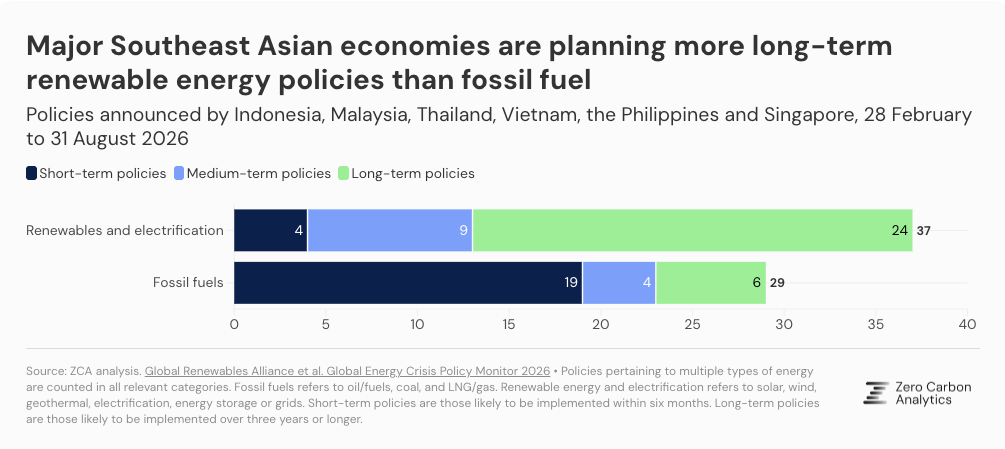
It seems some governments are aware of this, at least in aggregate. Some of the same countries are doing both consumer price subsidies and ramping up measures to cut fossil fuel dependence. In South-East Asia if the energy shock response measures are separated by time horizon, it turns out that long-term policies are more RES-focused, and shorter-term measures are more likely to cushion fossil fuel prices:
Rich countries in Europe, too, are also engaging in fuel subsidies or tax suspensions; the UK, France and Germany. Those are also countries whose governments are now contending with sceptical bond markets and higher borrowing costs.
This is where the rock of creditor-enforced fiscal discipline meets the hard place of politics; a familiar problem for poor countries that looks like becoming increasingly familiar in richer ones.
NEPAL
We explored the issue of higher public borrowing costs and shrinking fiscal space in our recent essay with Phenomenal World – but more in relation to climate damage and adaptation than energy transition. This was sparked by the horrific deadly disaster last month, when a large landslide crashed down mountains and sent debris and floodwaters through several rivers between Nepal and Tibet. Thousands of people are still missing and the death toll will likely be more than 6,000.
We started writing that essay by thinking about the idea of public investment in adaptation. Nepal has terribly limited fiscal space; it's one of the poorest countries in Asia. The disaster is expected to cost 10% of its annual GDP and the country had exited an IMF program only days before the tragedy occurred.
Nepal has applied for funds from the new multilateral "loss and damage" fund - but even if money is forthcoming, it won't be anywhere near adequate. The maximum that can be requested is $20mn, whereas the damage is measured in billions.
Nepal's prime minister, Balen Shah, said at the UNGA last week:
"We have built a world with flawless logistics for war and broken logistics for food.
"This is not Nepal's private misfortune. Ask Bangladesh. Ask Bhutan. Ask India. Ask the Maldives. Ask Pakistan. Ask Sri Lanka"
The shift (or weirdness) in Treasury markets in the last few months reached a new level as yields on 10-year bonds crept up closer to 5%, which it's now exceeded. There are multiple theories about what's driving this. One narrative about this rise is that the surge in AI-related debt issuance was “crowding out” demand for Treasuries. Another, related, explanation is that the shift in the type of owners of Treasuries – that is, an increasing proportion are hedge funds rather than entities that *must* own “safe assets”. The most sweeping and Polycrisis-adjacent theory is that it reflects an aversion to owning US assets at all.
There are less dramatic explanations: it’s simply the debt burden of the US (which hit $40 trillion last month and is historically quite high) or it's simply reflecting a return to more normal growth and inflationary trends, which have been absent for a lot of the post-2008 period of low-for-long rates and subdued growth. And don't forget the energy shock itself; oil prices and Treasury yields now have their highest correlation since the first Gulf War.
Whatever the reasons, most rich countries have higher debt levels and borrowing costs at precisely the moment that they are spending more on defense; that far right parties are successfully exploiting what is largely economic discontent; and that climate impacts worsen.
What’s a little surprising, amid all this, is that the bonds issued by governments of developing countries had mostly held up for most of the year. A weak US dollar has helped, and market reports cited fiscal discipline las another reason. Perhaps all that austerity under IMF programs and fears of default paid off – but only temporarily. The last few days emerging market dollar-denominated bonds have begun to sell off and are now showing negative returns for the year. It's one of the harshest aspects of the international monetary system that countries are punished by things outside of their control; this time it's fear that the energy crisis will never end which is causing markets to punish developing countries:
 David Feliba and Prima Wirayani and Mpho Hlakudi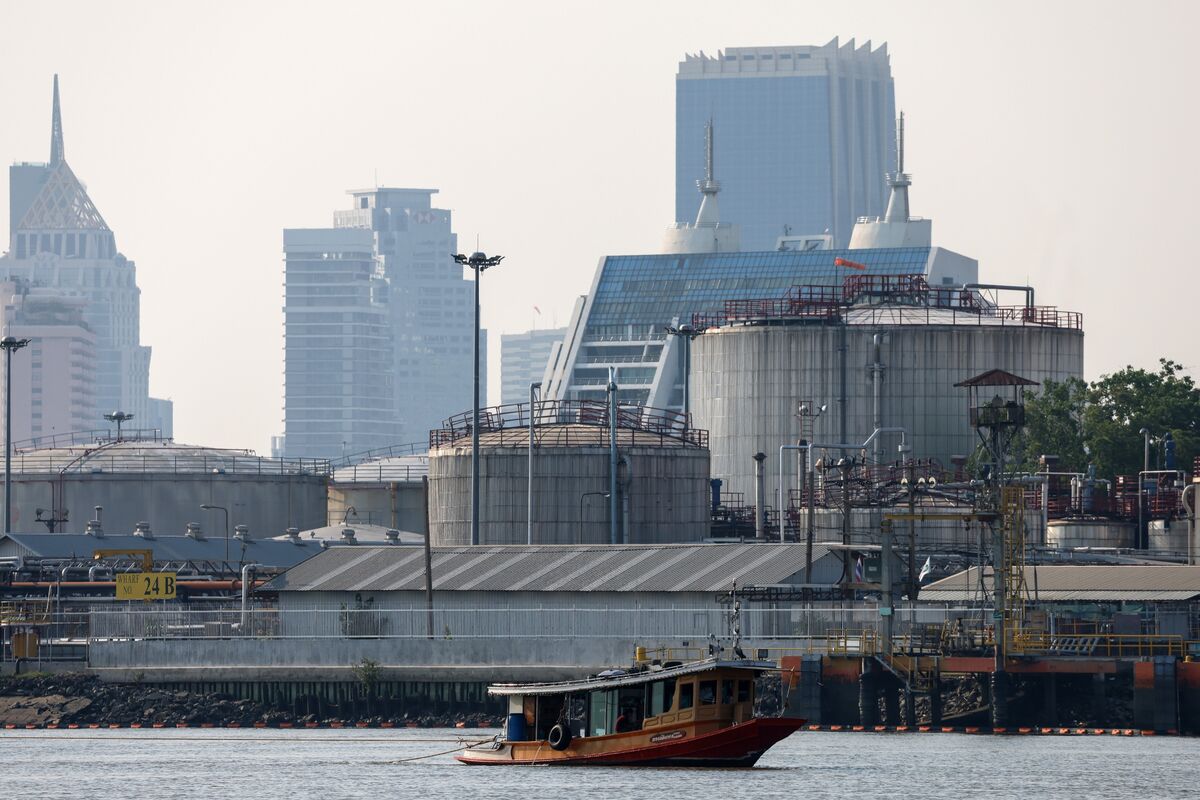
Programming note: Our AI podcast is coming
What better time to make a podcast on a topic than the moment it is causing high volume and chaotic discourse? But that’s what we are doing. We will look at AI through our usual lenses of geopolitics, political economy, energy, finance, development and more. It will be out in November.
Email us if you have strong views, please, about what or who should be included!
Exploring AI is fraught because of the risk of getting caught up in a nebulous p(doom) hysteria and taking attention away from other, very pressing problems. As we write this, a very big AI company has published a pre-IPO filing predictably warning of how it could pose an existential threat to humanity. Investors are predicted to be thrilled about the chance for a piece of this. As Brian Merchant writes, there are some plausible ways that these stories of existential threat are being amplified by the companies themselves for their own ends:
- AI companies are struggling to become or maintain profitability and some kind of industry-wide enforced slowdown buys them time
- AI companies want the regulatory moat to raise the barriers to entry for competititors
- They want to shape the nature of any regulation
Merchant, among others, suggests there's risk in getting caught up in the wrong stories, and as Henry Farrell notes, there is scarce critical research into AI that is not somehow connected to the industry itself, and shrinking public budgets for social sciences are worsening the problem. A new paper finds that the majority of papers about the biosecurity dangers posed by AI are linked to the Effective Altruist and longtermist movements.
There are more prosaic ways to look at why "AI agents" are lying and coordinating, including exploring whether there are fundamental problems with their training process as one of the world's most decorated computer scientists Yoshua Bengio reckons; and considering whether the companies whose models are "going rogue" are just taking a cavalier approach to cybersecurity, and raising the question of them wanting to escape political accountability and liability concerns.
LINKS
The Common Wealth crew make the case for a federal Power Authority to coordinate electricity decarbonization and affordability: “power should be at the center of the next generation of climate policy alongside a Public Investment Authority to provide the requisite fiscal firepower and economic coordination to solve the problem.”
AI risk is everywhere, making big fund managers & universal owners nervous (Bloomberg)
This guy is doing his PhD at Imperial College London, on a theme in part inspired by our writings! Thankyou Ben Shread-Hewitt, and bonne chance
- We will be back here soon! In the meantime, another plug for our survey