


On the rocks
The oil markets mystery, why Europe can't have good things
By Kate Mackenzie, Tim Sahay —
Clearing up the crude oil price confusion
The U.S.-Israeli war on Iran has dangerously escalated in the past two weeks, and prospects for fossil fuel and fertilizer logistics deteriorated further when Houthis emailed shipowners to inform them that the Red Sea southern gateway would no longer be a safe alternative. This adds millions of dollars in costs to each shipment from Saudi Arabia to Asia, according to Reuters estimates. Iran's furious military retaliation to U.S. air bases in the Gulf Kingdoms has killed American soldiers and made the risk of all-out war shoot up once again.
Crude oil futures prices have risen again to the significant $100 mark, but they’re still not anywhere near the $200 a barrel that a lot of analysts were predicting at the beginning of the conflict. There have been many attempts to explain why crude oil never reached the levels that the raw numbers of the supply crunch would suggest. China’s swift reduction in crude oil imports, which fell by almost half, is the biggest factor in alleviating market tightness. But that still leaves some questions: Why did markets not react in an anticipatory way? After all, almost no one foresaw that China would play the “swing consumer” role to such an extent. Yet in the biggest oil supply shock in history, crude oil futures contracts didn’t get anywhere near as high as experts predicted.
Rory Johnston, an oil analyst and "barrel counter," said toward the end of an Odd Lots episode late last month that he thinks the subdued price response was the combination of China’s surprising turn and Donald Trump’s regular declarations that the Strait of Hormuz was open, reliably timed to coincide with Monday’s crude-oil market open. Specifically, he said that oil traders who’d taken positions reasonably enough expecting a price spike kept getting roiled when Trump calmed markets most weekends, and their risk management colleagues subsequently limited their ability to make big calls.
Nathan Tankus highlighted that comment, and mulled over what it says about how oil markets work, in Notes on the Crises:
“What oil market participants — and people the world over — are learning is that the “social” limits on oil prices remaining aloof from supply and demand oil imbalances are much closer to physical limits than was commonly realized. In closely examining how the oil market has functioned during the Trump-Iran war we see how these markets are “conventional wisdom” processors, not information processors. We also see how a unitary executive imperial presidency in the hands of someone like Trump makes conventional wisdom, as understood by market participants, so bendable to Trump’s will.”
Oil markets have behaved in perplexing ways before, and the relationship between futures prices and physical reality has been the subject of vast amounts of analysis over the years. A lot of the contradictions and irregularities can be traced to factors like industry capital structure (lumpy and slow), supply and demand asymmetry, financial market artefacts, and tensions between paper markets and real world deliveries. Nathan is suggesting a different kind of information transmission problem, in which meaning is intentionally created by incredibly powerful actors.
Europe: pensions vs. protectionism
European capitals are galvanizing around the growing trade imbalance with China by imposing some form of tariffs. Since Sander Tordoir and Brad Setser wrote for CER that Europe should have its own version of the U.S. targeted Section 301 tariffs, the idea that Europe should sharpen its elbows has gained momentum. Even Germany is now on board, as Volkswagen prepares to cut tens of thousands of jobs. This piece by Jessie Yin at the Atlantic Council is a good overview.
But Cornel Ban writes that this talk fails to explain how Europe might actually prevail against China in such a contest. China, he writes, holds escalation dominance:
"It has more room to raise the stakes, more capacity to absorb the pain, and it has already shown, in its 2025 confrontation with the United States, that it will use both without hesitating. That confrontation with the U.S. wasn’t a close call. It was a rout, and it happened against the country that supposedly wrote the rules of economic coercion. If the European hawks have an explanation for why Europe, with a fraction of America’s leverage and a far more export-dependent economy, would fare better in the same fight this fall, they haven’t offered one."
Europe really is challenged in terms of its capacity to “bear pain,” which is a crucial weapon states can wield against bigger or more powerful rivals (see our essay on the logic behind Carney’s posture to the U.S.). But it's not quite fair to say that adherents of a more aggressive trade policy have neglected the question of Chinese retaliation. Tordoir and Setser proposed that the EU channel revenues from defensive measures towards China into a compensation mechanism for industries that might be selectively targeted by China, in response. As for the more ominous prospect of China cutting off critical supplies such as rare earths, their prescription is familiar: diversify supply chains. The question in all of these scenarios is whether enough time can be bought to make up the shortfall. And, almost as importantly, will it be used wisely?
Ban says the real solution is European industrial development, particularly the “second valley of death” of industrial scale. China, he estimates, is outspending Europe on supporting industrial development by a factor of about 10. His prescription is to utilize Europe’s $3 trillion pension pool. Better utilization of that pool of money has been kicked around for years, along with the idea of enlarging it – Europe's pensions pool is rather small, compared with the U.S., and European investment is very heavily intermediated by banks rather than capital markets.
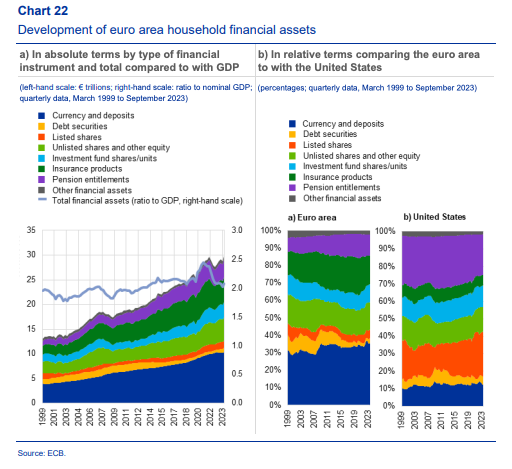
These are problems of both supply and demand. Some developments in the last couple of years, such as the "Pan European Personal Pension Product," have emerged falteringly; offerings and take-up are low. The Jacques Delors Centre earlier this year proposed an alternative product that would be more attractive to non-pension savers, more accessible, and structured and taxed in ways that could facilitate longer-term European investments.
China Squeeze vs. China Shock
Chinese authorities became very upset about the China Squeeze thesis put forward by the Peterson Institute for International Economics. We wrote about this thesis recently — it riffs on the “China Shock” idea in which cheap and voracious Chinese manufacturing subsumed large parts of the manufacturing industries of Western countries, hollowing out their middle classes. The "China Squeeze," instead, affects developing countries. It argues that as China moves up the value chain and makes more sophisticated goods, it still maintains a big role in simpler, lower-value-added manufacturing — thereby pulling the ladder up behind it for poorer countries seeking to make labor-intensive goods (like textiles and furniture) and thus closing down what has long been a key pathway for developing countries.
The vociferous protests from Chinese state-backed media over the past couple of weeks might seem like a contrast with the lack of interest in the China Shock narrative that’s now almost 20 years old:
https://t.co/aTJnTRtvFV pic.twitter.com/4XQ7s4lX6a
— Justin Sandefur (@JustinSandefur) July 15, 2026
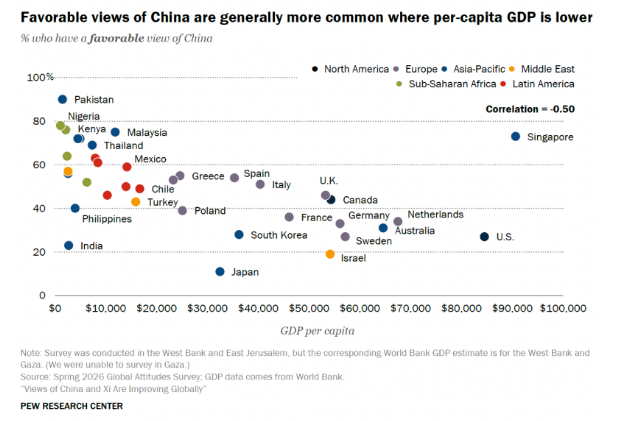
The difference in China’s outrage over Shock vs. Squeeze isn’t really surprising, though, if you’ve paid attention to China’s years of diplomacy and outreach to the Global South and its avid positioning of itself as the champion of multipolarity and multilateralism, and a more rules-based approach to world order than the existing one, which is presided over by the increasingly revisionist and might-makes-right approach of the U.S. Sadly, it’s something that rarely makes it very high up on the agenda in most news outlets. We’ve written about this a few times, but the people who are really tracking this are at the China Global South Project. Views of China from other countries are improving steadily, according to a report by Pew Research earlier this year, and are reliably more positive in poorer countries than richer ones.
Links:
How should countries engage with the U.S. — The latest collection of mini-essays from Caravanserai
Energy Trends, issue 189: Massive student Protests, wars and weak monsoons in this excellent weekly newsletter from India from
China's assault on Europe's car market has barely begun — a new series from the FT