Cars, climate, coal and... perovskite
Everyone has a plan until China makes more stuff
By Kate Mackenzie —
Europe's China moment; or is it a diesel moment?
An FT story has some dramatic quotes from European automakers about the plunge in demand for diesel vehicles. Diesel is both over-represented in European passenger car fleets and manufacturing, and particularly affected by the Hormuz crisis. "I think this is the end of diesel," said a senior Volvo executive, while another executive from an unnamed Asian manufacturer said "It's over for diesel." Stellantis's CEO: "said the company intended to continue to leverage diesel engines for “a little bit longer”, but admitted that there were “very few applications” for diesel other than for trucks and commercial vehicles".
The Stellantis guy sounds rather optimistic on the trucks question; more on that below.
The bigger context in all of this is not just fuel prices but also Chinese manufacturing. A kind of agreement was struck early this week between Europe and China that aims to halve Chinese plug-in hybrid vehicle imports to Europe – but will almost certainly result in more imports of electric-only vehicles (Shahin Vallee points out they could be almost double their recent levels next year, in one scenario). That cars agreement came just a few days after a significant Germany-France "non-paper" that called for a stronger stance to protect European manufacturers, and proposed a new trade weapon that would be more powerful and easier to implement than the EU's existing anti-coercion instrument, which can be vetoed by a minority of member states.
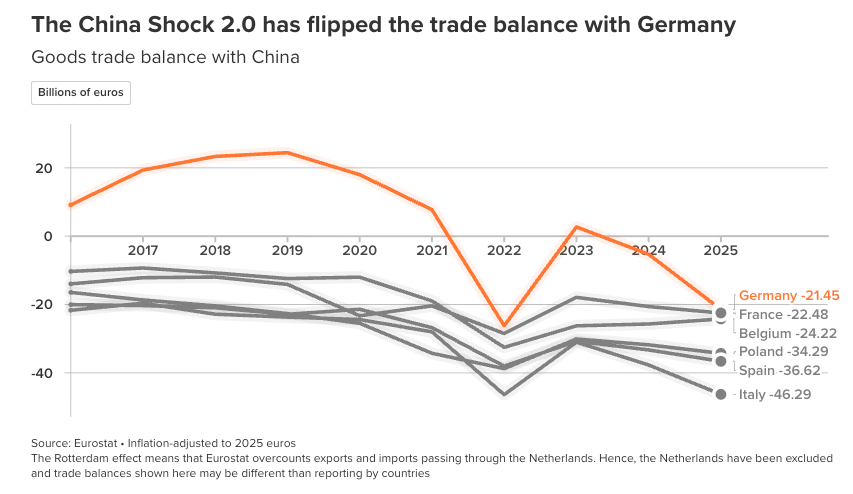
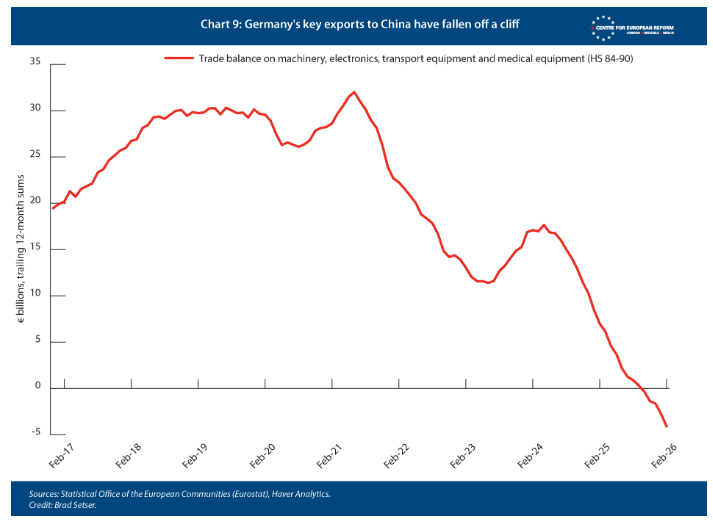
So, the biggest members of the bloc are united in seeing Chinese imports as a threat to their own local production – but Germany's hawkish stance on China is still relatively new. It's only a few months since Chancellor Merz expressed concerns about yuan valuation; not long after the country's trade balance with China swung negative – something most other European countries had been experiencing for years.
A big part of that shift in German politics over China was the sudden change in the Chinese car market. German sales to China dropped by a third last year; Volkswagen's sales to China fell by about 40% in the last two quarters alone, accelerating a steep decline since 2023. China was an important source of Volkswagen's revenue and profits for years, until Chinese buyers became more interested in local EVs. That in turn was – at least partly – the result of a very deliberate strategy by the European auto sector to try and preserve internal combustion engine markets as long as possible. They pushed back on EU vehicle efficiency rules and managed to water down the 2035 decarbonization target to 90%. Holding on to old style cars means European manufacturers are now rushing to improve EV technology and costs, even as they still work on incrementally improving ICE cars.
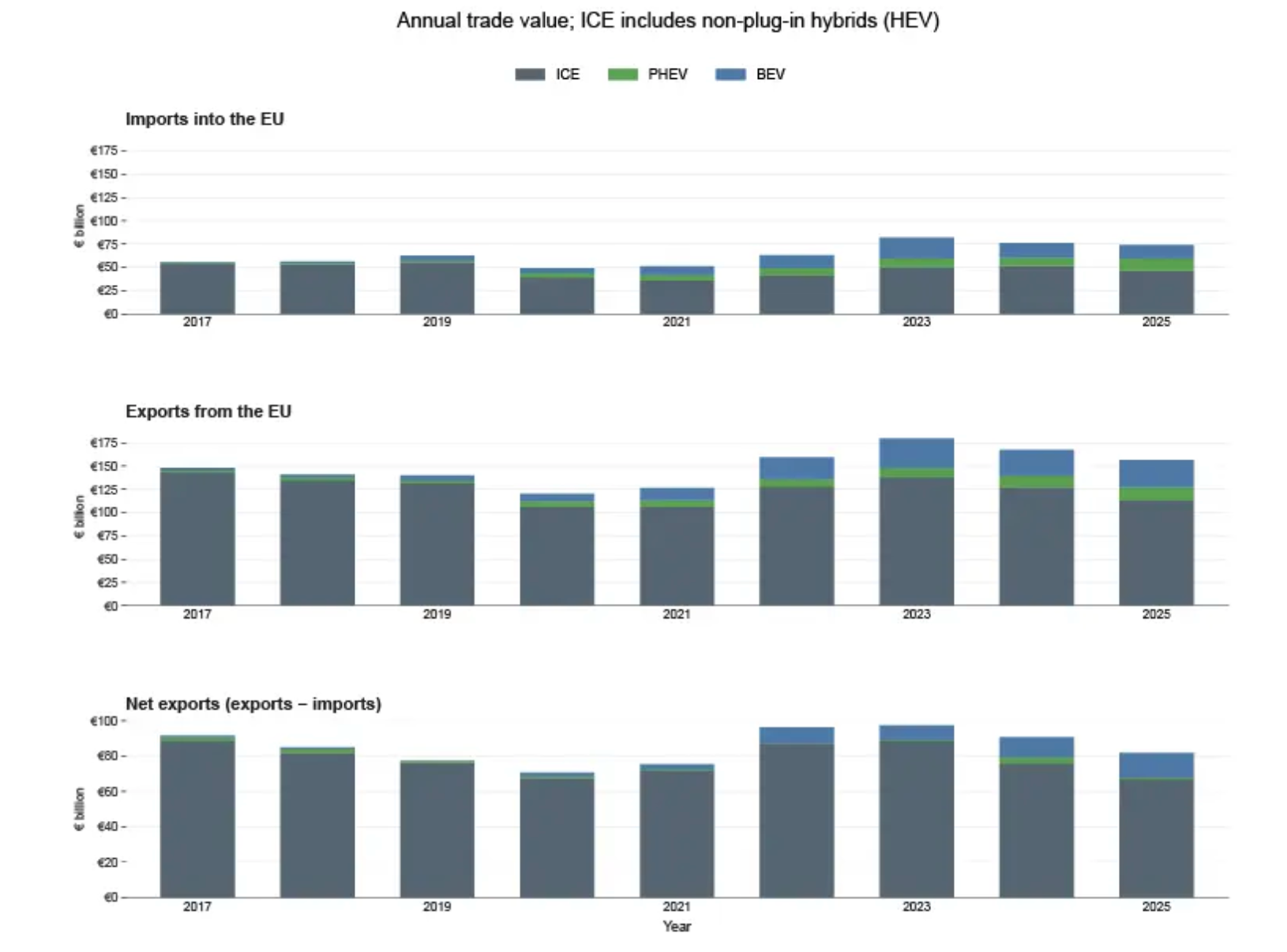
There are other problems for European autos; car sales in the continent are slightly lower than in 2019 and show no sign of increasing; one theory is that young people are less interested in owning cars. But looking at this data, via Bruegel, it's hard to conclude that preferencing ICE vehicles hasn't been a big contributor. Both net and gross exports of EVs and plug-in hybrids have staggered along for the last few years, while ICE exports have really suffered:
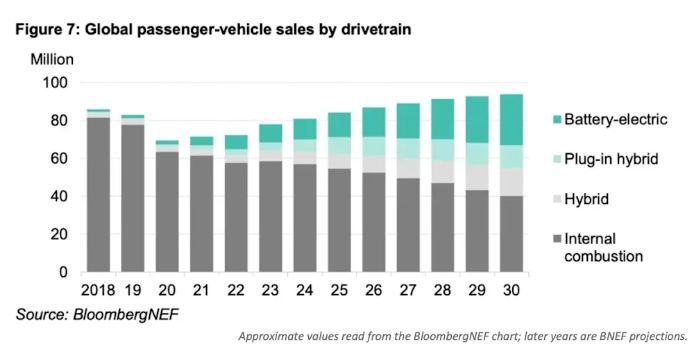
In China, too, car sales are falling – and China has plenty of excess capacity for manufacturing EVs, batteries, solar panels and wind turbine parts. Worldwide unused ICE car manufacturing capacity has grown particularly quickly; even assuming hybrids and plug-in hybrids share a lot of production with ICE cars, this chart shows the Covid cliff is at best a plateau.
And now, trucks?
The same decisions and poor timing that contributed to the European car industry's misfortune with EVs seem to be playing out again with trucks.
Europe is quite good at trucks; Daimler and Volvo are the world's biggest manufacturers. But as with passenger cars, electric trucks have become attractive more quickly than the Europeans were expecting; and the scenario is, again, similar: competitive Chinese companies (and Tesla) are quickly moving in on the Europe market.
And they are, overall, offering a somewhat better product. It's not quite the gap on pricing that's seen with Chinese passenger EVs, which are in the range of €20,000 cheaper than European equivalents before tariffs, and still competitive even after tariffs. Transport and Environment puts the total cost of ownership of "new entrant" electric trucks at about 9% lower than European-made ones. They're competitive on things like servicing networks, which matter to truck operating companies.
As with cars, truck manufacturers have sought to weaken requirements to cut emissions of their total fleet sales. Emissions have to be 15% below 2019 levels by 2025; and -45% by 2030. European truck makers (who lead the global industry) successfully lobbied to stagger the speed at which the new restrictions are phased in.
T&E also says that "new entrants" (which include Tesla, but are mostly Chinese companies) are targeting growth in Europe that suggests they'll account for between a quarter and a third of European EV sales by 2030.
At this point we should note that it's not just autos that are an issue for German manufacturing! Chemicals, machinery, and specialist equipment are some of the other categories under pressure. Here's a chart of some other German export sectors, from Brad Setser in his paper with Sander Tordoir earlier this year that chided Germany's inaction on the shift in its trade balance with China:
China's outbound energy investment
One of the most interesting things about the conversation with IEEFA's Haneea Isaad for our first The Polycrisis podcast season was the story she told about a clash between Pakistan's new solar power generation boom (courtesy of cheap Chinese imports) and the legacy of debt from coal-fired power plants... that were financed by Chinese companies.
That coal power plant debt makes it harder for Pakistan to realize savings that come from solar power through grid electricity; because the utilities are saddled with debt servicing even when a lot of the coal power plant generation isn't needed anymore.
It illustrates a whole bunch of issues: the diversity within China's international strategies and its economic model; the debt dynamics affecting poorer countries; and the unfortunate short-sightedness of going all-in on fossil fuel projects just a few years before they became very obviously uneconomic. It also underlines that the newer iteration of the Belt and Road Initiative is far less coordinated than the original.
Lili Pike and Faseeh Mangi at Bloomberg looked at this more closely – the implications for both China and Pakistan – and other countries too, like South Africa, which has some similarities to Pakistan (boom in solar power denuding the economics of the grid industry; some of which is indebted to Chinese companies).
Of course the big question now, in terms of future energy use, manufacturing and development is whether Chinese clean tech manufacturing knowhow and IP will be transferred to other countries. There are two sides to the equation: other countries need to bargain astutely with Chinese companies, but the Chinese state also has to come to the party. There were reports a few months ago of Chinese solar manufacturing products being banned from export to India which had a material effect on India's solar production; now China has said it may ban exports of various solar manufacturing technologies and knowhow relating to perovskite, polysilicon, wafers, cells, and more. While these remain proposals, PV Magazine reports that an interim requirement to register exports of these technologies was introduced yesterday, adding: "In the near term, the measures could delay overseas PV manufacturing projects, increase compliance costs and limit the deployment of advanced Chinese production technologies abroad. Over the longer term, the restrictions could strengthen China’s influence over the international diffusion of next-generation PV manufacturing technologies, potentially slowing efforts by overseas manufacturers to close the technological gap."
LINKS
Perry Mehrling, an incredible scholar of finance, passed away this week.
"Where is politics in the money view?" The Money View is Mehrling's way of systematizing the practitioner view of the money-finance system — which he described as one that is a public-private hybrid in which the touch points between public and private are constantly contested, and in which discipline vs elasticity is the subject of contestation.
Thanks to reader Ben Gilvar-Parke for that link, and also to one of Perry's courses, which is fully available for free online. And Nathan Tankus wrote a lovely post about Mehrling, and Robert Skidelsky, who also passed away earlier this year, and and Anwar Shaikh, who passed away this month.