
This week's Dispatch is mostly about the Brazil election – how it happened and particularly the market over-reaction, which we think didn't get enough attention. Also: introducing our new podcast season! Follow it here (Apple, Spotify).
In the meantime, you can join our Discord to join, or email us (Kate, Tim)
The market hissy fit
On news of Lula's re-election victory, the value of every Brazilian asset class crashed. Financial press attributed this to Lula’s copious spending promises on the campaign trail “including free public transport at weekends, debt forgiveness for individuals and increased welfare payments".
Markets often sell off when a progressive candidate wins. But Bloomberg’s John Authers noted, this reaction was extreme. A dollar-denominated ETF tracking the Brazilian MSCI index fell 25% in a day – Black Monday levels:
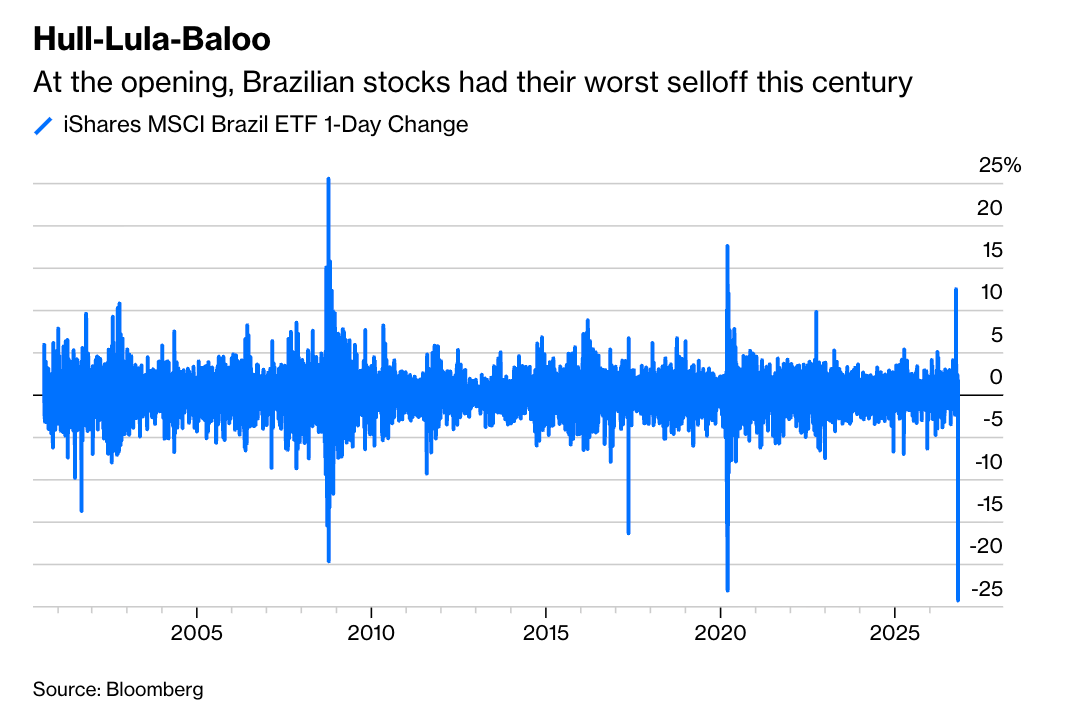
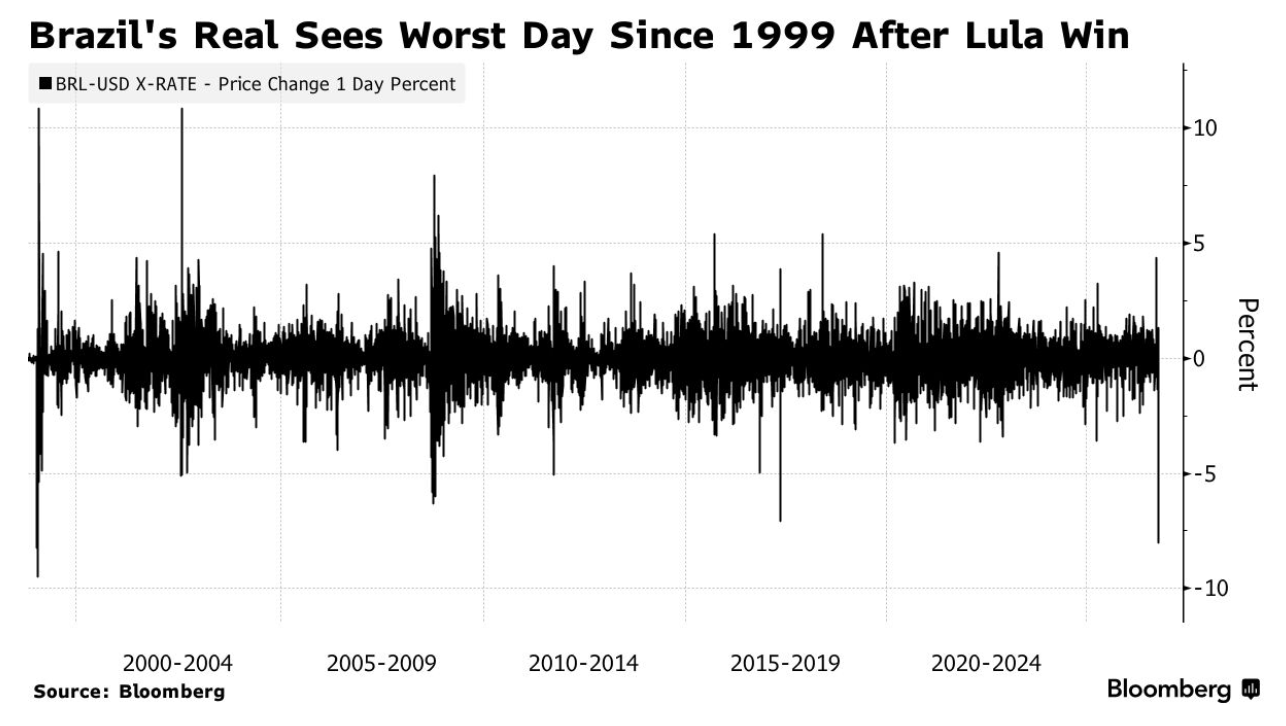
It was the same everywhere; the Real crashed; government bond yields were up a couple of percentage points, credit default swaps on them spiked.
The driver was dismay by those who'd bought into a narrative of fiscal consolidation by Flávio Bolsonaro. The premise of those dashed hopes was always thin, though, even by its own logic. As Rebecca Patterson wrote for Council on Foreign Relations (well before the run-off), Bolsonaro's pledge of almost $40bn of fiscal adjustment was to be achieved almost entirely through spending cuts, reducing the size of government and privatisation – but his official governance plan didn't outline how this would save or boost growth. Furthermore, in the later weeks of the campaign he agreed to maintain some social spending levels, including continuing to raise pensions above the rate of inflation (just under 4.6 percent over the past year), and dismissed reports that he planned to halt real minimum wage increases.
Patterson also points out that constitutional rules determine the vast majority of Brazil's budget, leaving little room for dramatic shifts.
Fears about the fiscal prospects under the next Lula government seem similarly overblown. The same budget restraints limits the new government, too, and right-wing parties will have a stronger role in the new parliament, suggesting there'll be more political constraint and compromise. Brazil has hardly performed badly under Lula, either – as Robert Kuttner pointed out in American Prospect, Brazil’s average GDP growth has been a relatively flourishing 3% under Lula’s 4-year term.
Brazil’s debt-to-GDP ratio at 82%, is on the high side relative to its emerging market peers. However, it’s significantly below every G7 country except Germany; and Brazil is one of the least vulnerable emerging markets. Most government borrowing is done in local currency, with the debt is locally owned.
The most recent IMF Article IV review, published in June, was almost glowing; concerns about debt were accompanied by statement of confidence in the government's commitment to managing it:
“[Executive directors] welcomed Brazil’s continued economic resilience, despite the challenging external environment, alongside declining poverty and inequality. Positively noting Brazil’s strong buffers and policy frameworks, Directors encouraged the authorities to strengthen fiscal sustainability, ensure inflation converges to target, and advance structural reforms to boost inclusive growth. Directors commended the authorities’ ongoing efforts and welcomed their continued commitment to improving the fiscal position over the medium term."
Nevertheless, as Bloomberg's Authers wrote, the foreign passive flows that drive Latin American stock markets have a "strong and well-marked tendency to freak out at any sign of victory for candidates on the political left". There are plenty of reports of Brazilian hedge funds making big bets on local equities, and Wall Street analysts advising their clients to do the same.
Some of the fall was just corrective – reversing gains that were made in Bolsonaro’s victory in the first round:
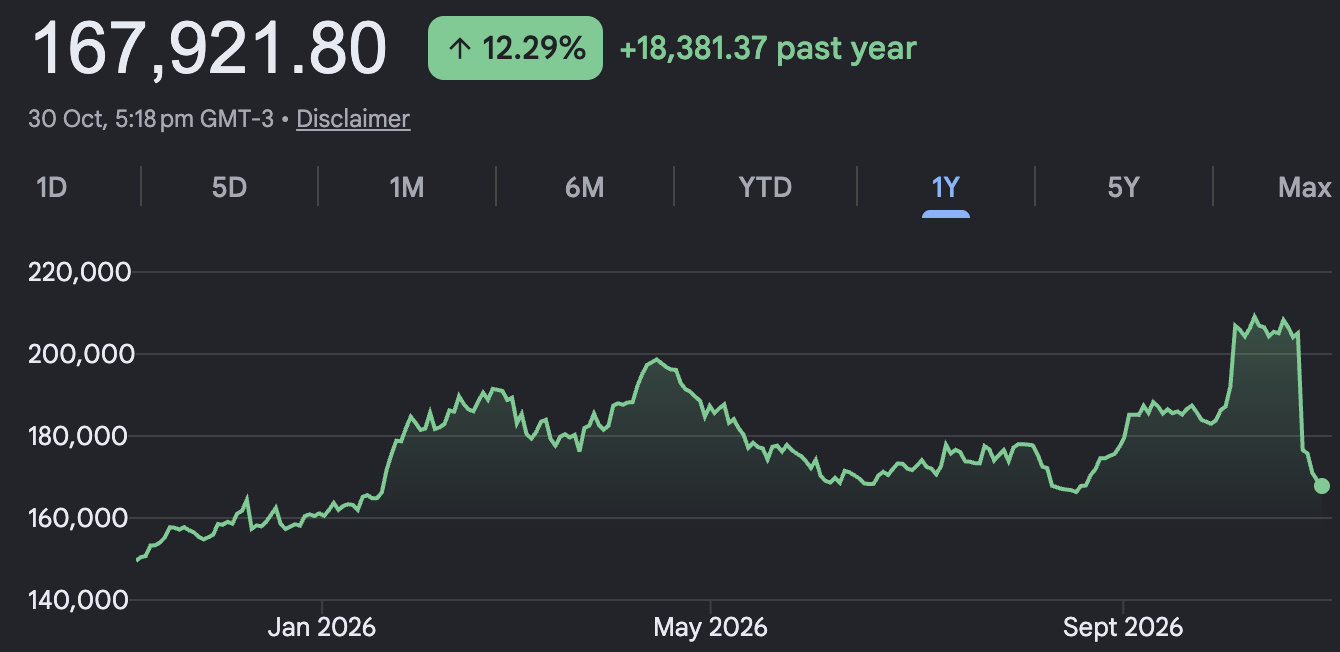
What's most striking is how the market response to Lula's win was reported: not as an artefact of market behaviour and composition, but as a marker of a self-evident truth that fiscal discipline was now necessary.
How did Lula turn it around?
What went wrong for Lula and the PT (Workers’ Party) in the first round, where Flávio Bolsonaro won a decisive victory? Consensus is that the PT party machinery struggled to connect with, let alone inspire, the swathe of voters who were struggling with limited opportunities characterised by poverty, gig work and thwarted aspiration.
The picture painted by Anna Carolino Raposo de Mello in Equator could apply to almost any incumbent government of the left, centre-left or even centre-right:
The president’s supporters seemed resigned to a tight victory and an uneventful continuity of government. This despite a general consensus that, during Lula’s third term, the PT had become disconnected from Brazil’s new working class, those small entrepreneurs and gig-economy workers with aspirations of individual prosperity and high-end consumption rather than inclusive public policy and participation in collective struggle. Flávio Bolsonaro’s side, conversely, capitalised on the widespread desire for change.
The dramatic shift had a few origins – getting out the vote; getting people to vote differently (blank votes dropped sharply in the second round); a powerful digital campaign and ground game; and actual policies and measures to alleviate economic distress.
The digital campaign
A lot of the turnaround was attributed to the “Lula’s Army” WhatsApp group created by André Janones, a progressive politician, in the aftermath of the first round of voting. Its membership quickly grew to 10 million― or about 1 member for every 17 adults in Brazil―and about the same number by which Lula’s vote total increased between the first and second round.
Janones who urged everyone to persuade one person and to embrace the discipline required to not be undermined by the tech platforms: don't engage with far-right content; don’t trust the algorithms; do put effort into your private group chats and the people you know who can be persuaded. The exercise demonstrated that the platforms of big tech are not determinedly tools of the right, despite their design and their leadership both leaning that way. Social media, for all its problems, is still a viable battleground.
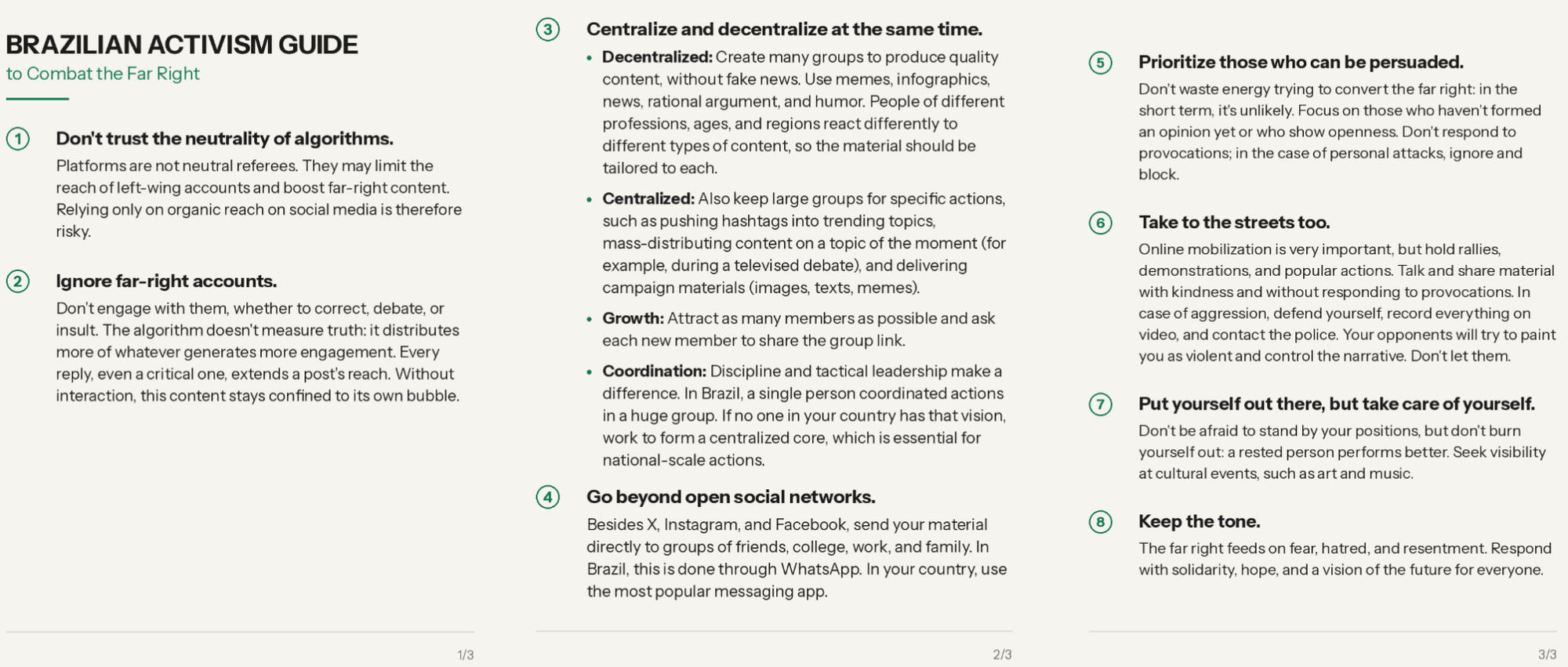
Janone’s strategy is now going viral in political campaign circles. Spain’s socialist Prime Minister Pedro Sánchez, facing a tight re-election in polarized Spain has requested Janones’s expertise, and in France, activists are studying "Janonisme" to fight the far-right.
Also in the period before the run-off vote, several popular Lula or PT measures were advanced, including broader eligibility for support for left-behind Bolsonaristas (small businesses, self-employed, not formal union people) such as debt forgiveness via local commercial banks. There were also expanded diesel subsidies and cut fuel taxes (link), and progression towards cutting working hours from 44 to 40, thus ending the 6-day week.
At the same time, it helped that Bolsonaro became increasingly unattractive in the second part of the campaign, with a poor performance in public debates. His platform was uninspiring – arresting wage increases, and a harsh law-and-order campaign including building five El Salvador CECOT-style prisons. There was also his overtures to the US administration; in May visit to the White House, he obtained a terrorist designation for Brazilian drug groups.
This US outreach was offputting to many Brazilians. The country does not rely heavily on US import markets, but Trump had already sought to impose punitive tariffs of 50% to pressure Brazil over the prosecution of former president, Jair Bolsonaro.
In the North-South Notes newsletter ahead of the election, political scientist Camila Rocha warned that “the election of Flávio would mean, in practice, Trump’s total domination of South America; it would also reduce Brazil’s sovereignty to dust”. In the same edition, journalist Piero Locatelli noted that Flávio’s role in US incursion on Brazilian sovereignty was impossible to ignore:
Since 1989, when democracy returned to Brazil, the idea that electoral politics were subject to foreign influence has been mocked and cast to the margins of “public debate.”
All this changed, in part because Trump’s modus operandi is blatant:
[Trump’s] lack of subtlety makes the machinations impossible to miss: Brazilian businessmen admit on podcasts that they are part of U.S. networks that work with Brazilian campaigns; firms linked to Donald Trump, Jr. invest in the extraction of rare earth minerals here; and Republican officials do paid advertising spots promoting Flávio’s chances on Polymarket.
And then there are Trump’s actual policies. Brazil has been the target of a series of measures, such as the imposition of tariffs, Magnitsky Law sanctions, and the revocation of visas held by Supreme Court Justices. All of this had the open support of Eduardo Bolsonaro, Flávio’s younger brother, who now lives in Texas.
New podcast alert
We released a new podcast season, Silicon World Order – and yes, it is about AI.
This is quite different to our first season, “Electric World Order”, which had a neat arc from the solar installation boom in Pakistan to the Chinese economic-industrial strategy that enabled it, the politics of the US divergence away from clean energy, and the implications for developing countries and for oil exporters. The direction of travel there is clear, relative to the AI industry, where some of the implications are still very much unfolding across multiple systems: labour, society, politics.
We started by thinking about the real-world and financial threads: after years and years of investment capital sitting on the sidelines – for energy transition, basic infrastructure, development – it’s now piling into One Cool Trick at a monumental scale. One of the taglines of the new podcast season is, "Not the investment boom we wanted – but the one we’ve got".
Another is: "How can it be made better?" We’re believers in the potential of technology. But even asking that question is leaning on the side of credulity – allowing nightmarish sci-fi p(doom) spectres to take up space when so many real problems and challenges already exist. So, we looked at what can we know and understand, already – like infrastructure, energy, sovereignty, and military applications – and talked to some of the people who have interesting things to say about risks and possibilities that are already evident. Our interviewees include Henry Farrell, Cecilia Rikap, Anna Hehir and our friend Advait Arun. You can subscribe here (Apple, Spotify).