Tech, tariffs and trade-offs
Europe's industrial-decarb-tech-soveriegnty options; COP31
By Kate Mackenzie, Advait Arun —
Can Europe be better?
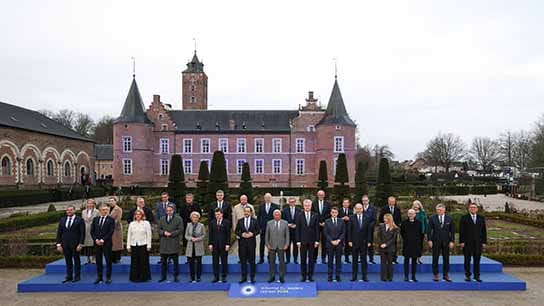
Kate and Advait recently visited Madrid, where we participated in Instituto Meridiano’s “Constructing the Future” plenary on Spanish and European climate politics. The event brought together industrial policy scholars, technologists and decarbonization experts for discussions ranging from the future of China-Europe bilateral investment relationships to the principles for European tech sovereignty to the changing geopolitics of global decarbonization. We heard about the “too-little-too-late” nature of the Industrial Accelerator Act and the minutiae of Chinese car and battery firms’ joint venture arrangements. We presented on the United States’ withdrawal from responsible global climate governance and how the Global South is using Chinese technology imports as a shock absorber against global macroeconomic volatility.
Hanging like an axe over the content of the conference, however, were the specters of the upcoming Spanish election and an inflexible pan-European political economy. We found it hard to avoid these topics in conversations around the conference.
First, Spain: For all of Spain’s progress over the past fifteen years as a healthy economy growing at a fast clip and rapidly expanding its clean energy and clean technology sectors, the Spanish conservative party―the People’s Party―is favored to win the upcoming elections. That will potentially slow Spain’s decarbonization progress and walk back the country’s posture toward Chinese joint ventures, which has been mostly welcoming (Spain hosts a joint venture with EV maker Chery at a former Nissan plant, and a large CATL battery factory is under construction). The elections take place this weekend and the outcome will also be determined by what sort of coalitions might be formed in its aftermath.
Then, Europe. EU’s Industrial Accelerator Act featured in several presentations. It’s broadly agreed the IAA will be insufficient at spurring new investment, and what struck us at the conference is that any benefits from these measures are quite a long way off in the future:
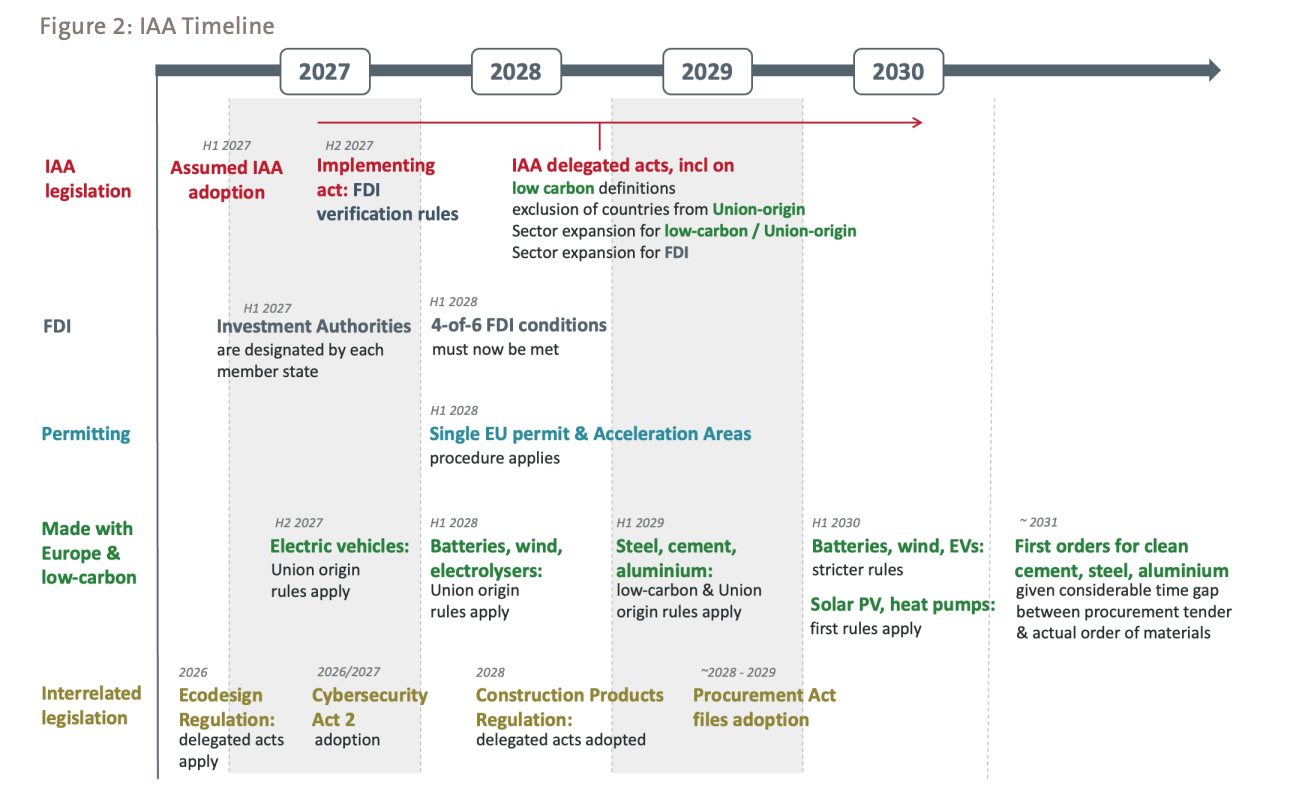
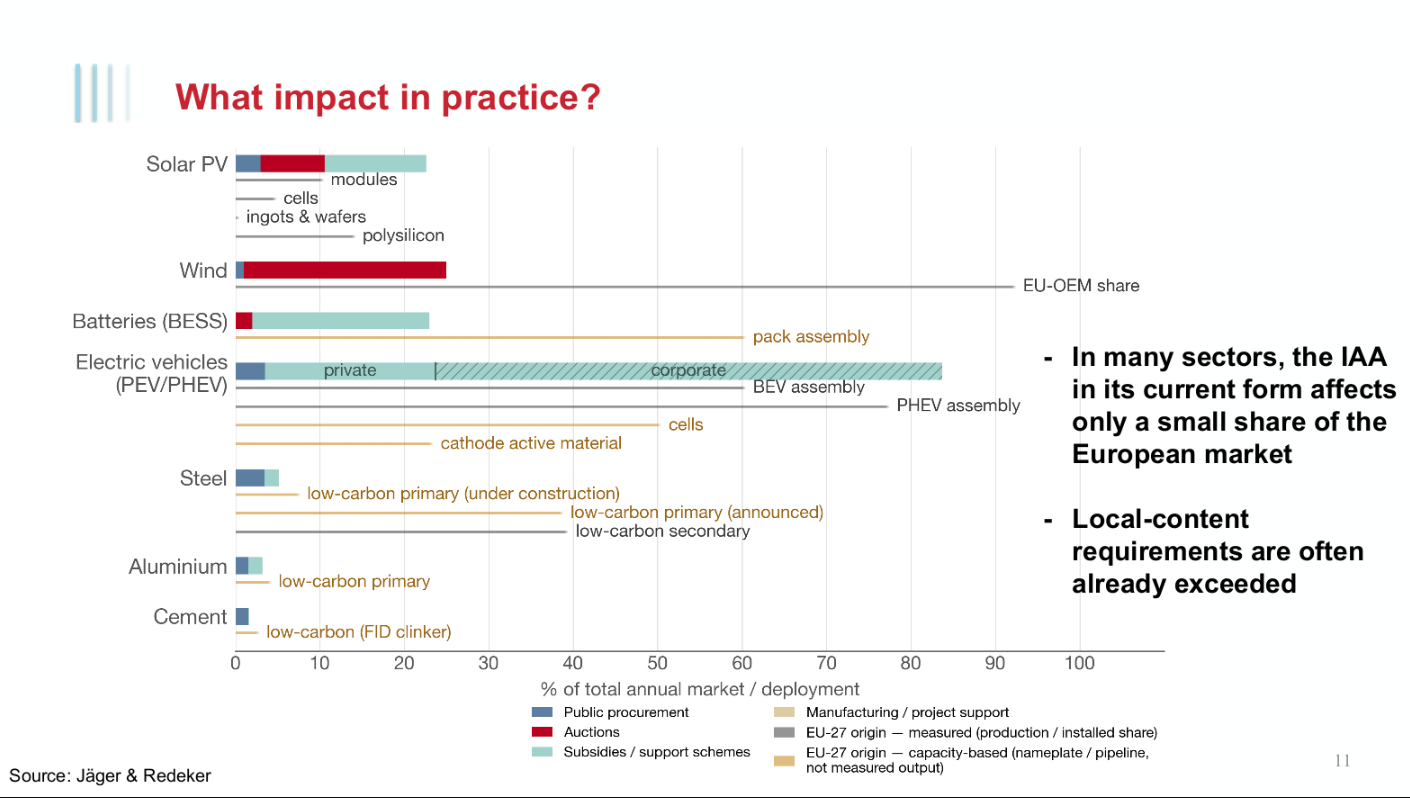
Both are from a paper by Philipp Jäger and Nils Redeker at Jacques Delors Centre/Hertie School
We also heard worry about the increasing irrelevance of most of the European Commission and the retrogression of European politics back to the bloc’s national capitals. To be sure, the national capitals have always been the true loci of Europe’s power. But there was real dismay at the EU’s inability to, for example, pick a single lead diplomat to represent the bloc in negotiations with the United States, Russia, and Ukraine over a potential settlement to Russia’s war. That will look like a small problem next to the prospect of an anti-EU French president taking power next year.
We discussed the usual reasons the EU cannot punch at its weight globally: the lack of a unified capital market balanced by EU-level borrowing and reforms to state aid rules; the bloc’s dependence on American security guarantees, LNG, and tech companies despite growing awareness across Brussels that such dependence keeps causing problems; and persistent disagreement over how to engage with and learn from China’s industrial ecosystem.
A right-wing turn in Spain’s governance would likely prevent Europe’s fourth-largest economy from putting its weight decisively behind any of these transformations―and potential right-wing gains in France and Germany suggest that Europe will only move slower into a greater awareness of its precarious geopolitical position, not faster.
On that last point, Palma Polyak spoke at Construir el Futuro about her fascinating research into European battery manufacturing; often a product of foreign direct investment (most notably from China and Korea) and how states are ensuring that this growing industry is a source of good jobs and environmental sustainability, as well as producing emissions-cutting devices. Some countries, she notes, have taken a “low road” approach in which they accept foreign investment in battery facilities with minimal provisions for labour rights, tech transfer and environmental protection, while others take a “high road” approach (the failed Swedish company, Northvolt, being an unhappy example, but others like Verkor and ACC still exist).
The political coalitions necessary to take a “high road” approach are fragile and countries deploying them are vulnerable to being undercut by other EU member states pursuing a “low road” strategy. As Palma writes in a recent paper on this work: “Subverted aims are not a bug: They are wired into an EU policy regime that does not clearly prioritize between its aims or operationalize them in binding ways.”
This was a common theme: even with its numerous institutional constraints and divisions between member states, the EU could probably be doing more with the tools and capacity that it has. The bloc reacts to the shock of the shift from the US, its tilt towards sovereignty and industrial policy is still held back by a legacy of neoliberalism.
This was evident in the session on technology, too. Tech wasn’t a core topic we focused on when launching The Polycrisis in 2022, and it might seem orthogonal to the climate theme of the conference, but, as most of our readers will know – almost everything is climate-related, (and energy-related, politics-related, industry-related).
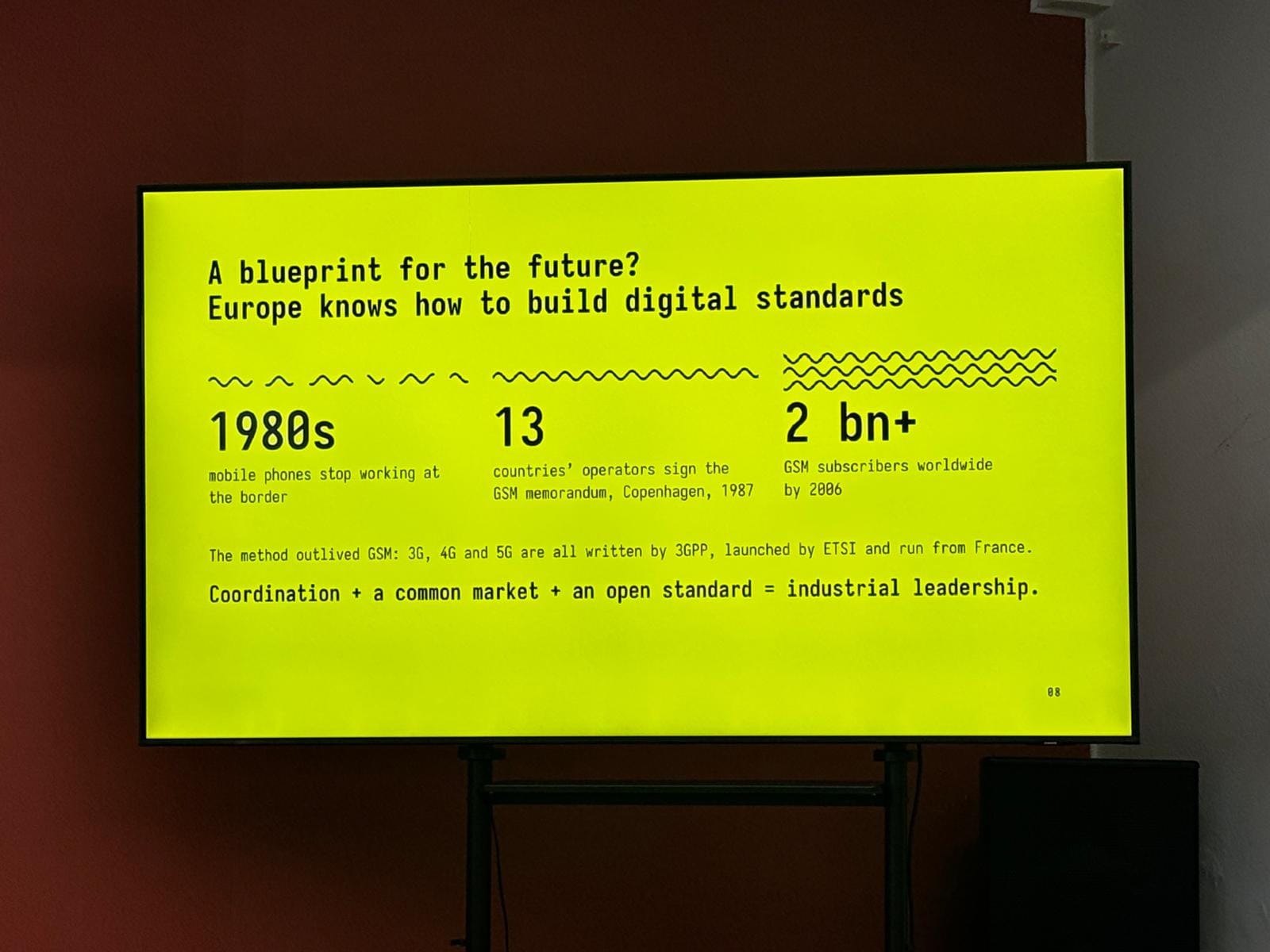
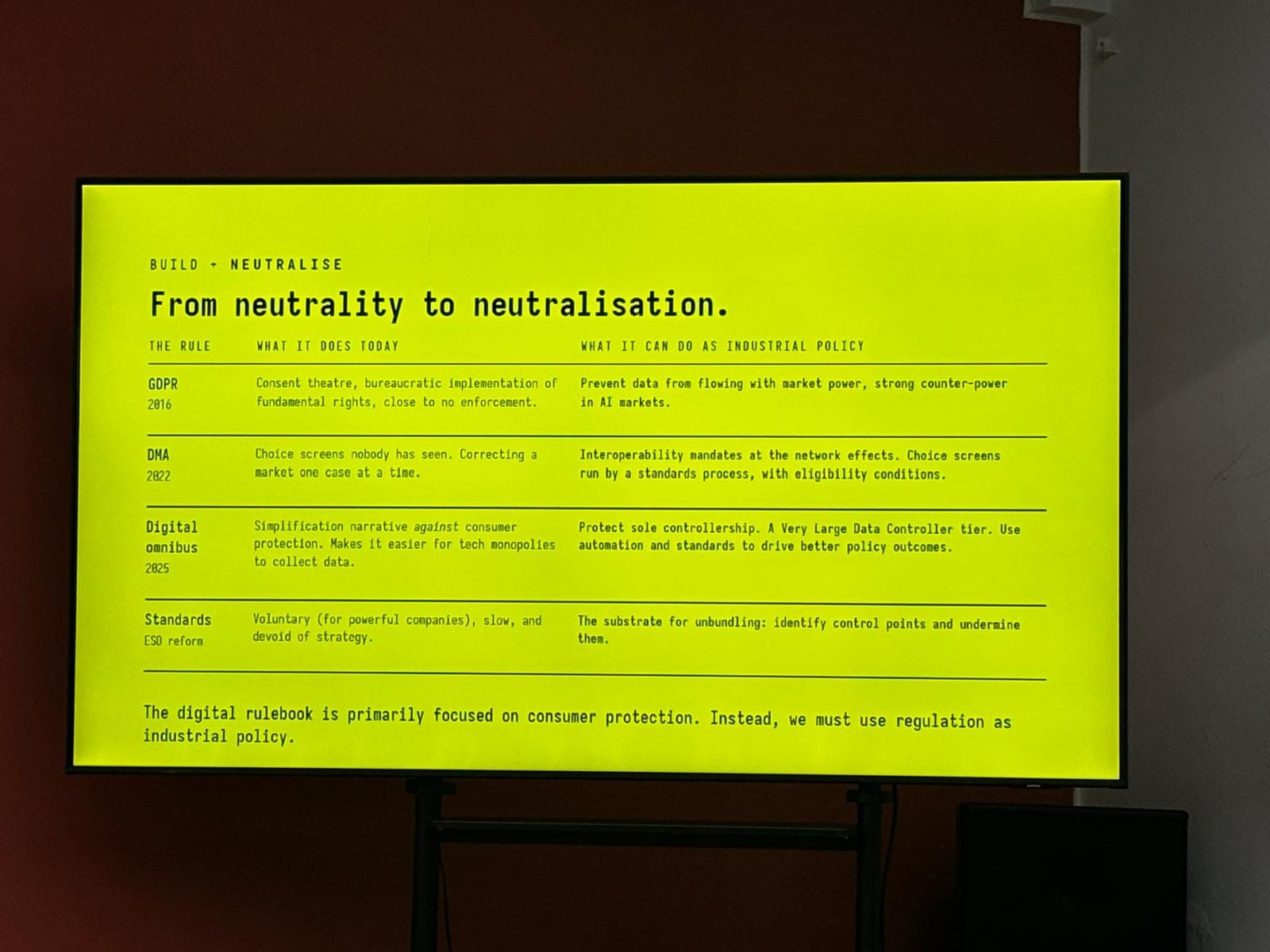
A panel with Xan López and Robin Berjon highlighted the extensive power of US tech firms across the tech stack, with its increasingly dark implications for European sovereignty. Once again, the EU could be different – even within its existing political constraints. (The potential to internationalize the euro is another example.)
Some of Robin’s presentation highlighted that Europe not only has a strong background in technology, but in tech industrial policy that underpins open standards and platforms:
Thanks again to Institute Meridiano for inviting us and facilitating some very rich discussions. IM is a new think tank and policy organization devoted to building a progressive and growth-forward vision of decarbonization in Spain, and is well-poised to remain a generative home for discussions of topics like these. Their writing on the future of European climate politics is well worth following.
***
COP31
COP31 ended without a cover agreement after numerous countries objected to the removal of any reference to fossil fuels. “Cover agreements” are not a ubiquitous feature of the UNFCCC conferences, however, as Simon Evans from Carbon Brief points out – they’ve become a higher profile component since the UK COP26 in 2021, when that country’s government was determined to deliver a successful, finance-flavoured conference. A COP veteran, Alden Meyer, told Carbon Brief that the bigger issue was Saudi Arabia and Russia blocking the adoption of an expanded Mitigation Work Program – in the closing hours of the conference, representatives from both countries argued that this would overstep the Convention’s mandate by determining how countries needed to cut emissions. What’s interesting to us is that the views of the most obstructionist petrostates are becoming more and more visible.
Tensions over climate finance continued. Before the conference, EU climate commissioner Wopke Hoekstra told Bloomberg that a new climate finance deal was “dead in the water” and COP31 co-president, Australia, was reportedly unenthusiastic about the finance agenda on the grounds of this event being “not a finance COP”. For Global South countries, though, every conference is about finance.
This was also the biggest COP ever; with more than 90,000 attendees. COPs have long resembled, in part, something like a trade show. Bloomberg's Lili Pike wrote about the big presence of Chinese clean tech export firms:
Every day across from the negotiating halls, China's cleantech firms were on stage at the China pavilion and off stage chasing deals. From LONGi to Ming Yang, execs told me they see the annual talks as worth attending despite their busy trade show schedules because they provide a chance to meet potential partners and government officials from nearly 200 countries – markets they increasingly need as demand growth slows at home.
This sort of cleantech corporate presence was visible at last year's COP in Brazil, and Chinese officials even talked about its cleantech exports as a contribution to global decarbonization. It's sounding more and more like the "strategic green industrial diplomacy" we anticipated in 2024.
LINKS
- DRC is implementing a requirement for mining companies to make 10% of their value available to local investors. Glencore and China's CMOC have asked for more time. (Via China Global South Project). DRC is one of the African countries that have recently implemented export controls on their raw minerals; effectively raising the price of cobalt by implementing quotas and temporary export bans (a new ban was just announced this week as prices have slumped). It's also creating strategic reserves of cobalt, coltan and germanium.
- Critical minerals in adversarial times modelling: a stockpile/floor pricing optimization paper and game from Alex Turnbull.
- Control point analysis: A paper from 2012 by David Clark that sets out an informal method for identifying who can exert direct control on internet architecture.