

Videos
Book Club: Against Money
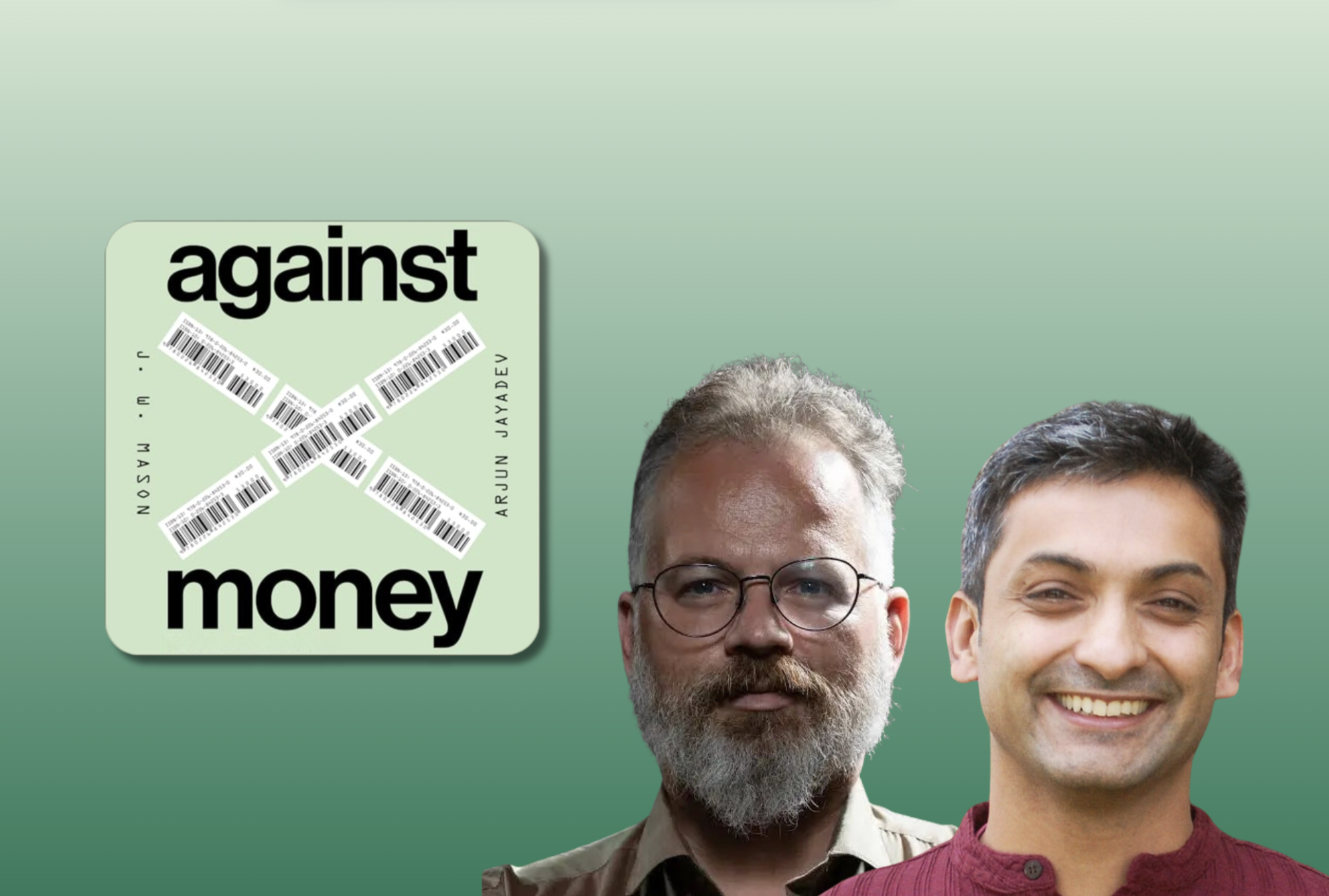
Recording of our discussion with Arjun Jayadev and JW Mason on their new book, Against Money.
By Tim Sahay, Kate Mackenzie —
On June 29, we recorded a discussion with Arjun Jayadev and JW Mason on their new book, Against Money.
You can find the video here, and below are a couple of excerpts.
Arjun Jayadev on the three meanings of Against Money:
"The first is against thinking about money the way, if you will, the mainstream has thought about it, as a kind of convenience instead of barter – which leads you down some very strange paths.
"The second was to make the distinction between money and the world behind it. There's a belief that we have that we think of the world against money, as it were, right? So there's a kind of foreground-background understanding, and we really felt like you have to understand money in and of its own terms, and not constantly put these two together.
"And then finally, of course, against the rule of money. As we were writing, it became really clear to us. We originally thought the book would be called Money and Things, because it's about the world of money and the world of things. But the relentless attempt — and not among economists, but among the world at large — to see the world as money-like is actually very debilitating, and we wanted to move away from that."
JW Mason on the fallacy of trade-offs between consumption now and climate action:
"When we start taking the monetary production view, we realize we don't know the possibilities of production, and the possibilities of production really don't exist until we actually carry things out.
"We're seeing this so vividly today with solar energy, with battery technology: when you actually invest in these things at a large scale, the costs to do them come down in ways often that were just completely not predicted beforehand, that were not in any way knowable beforehand.
"So … on the one hand, we're wrong to imagine a set of hard trade-offs where we can put a value on various environmental goods, and then compare that in a quantitative way to the things we'd like to consume. But we're also wrong to imagine that the constraint is something that we can know in advance. Here's how much we can produce, and we're going to have to devote it in this way or that way.
"And one implication of that — which I think we're going to hopefully see in a revision of the Green New Deal discourse at some point, may or may not be under that name — is that a real serious climate program can very easily, in fact, in my view, almost certainly will, raise living standards for the vast majority of people in the short run."
JW Mason on getting beyond the constraints of prevailing concepts of money:
"In the final chapter, we suggest that this vision of the world in terms of money, the idea — or, sort of, the fact — that money is naturalized and treated as an objective measure, something that is out there already, some value, some quantity of capital, some quantity of output that already exists.
"The fact that we naturalize money that way and treat it as a transparent window into a world that actually doesn't exist makes us think that the world is much more marketized, much more commodified than it actually is. It blinds us to all the forms of planning, all the other forms of cooperation and coordination that already exist.
"And we think, therefore, it makes the problem of a transition to a different kind of system seem much more daunting than it necessarily needs to be."
The book ends with the view that "in a way, we're much closer to a more socialized, democratic economic system than we imagine, because we exaggerate the role of markets and property and money in organizing production in the world we live in."