Understanding China w/Tim Sahay, Li Shuo and Jeremy Wallace
Verso Books offices in Manhattan, New York, 23rd September 2026
On 23 September, The Break—Down launched its fourth print issue with a live conversation on China and the climate at Verso Books’ Manhattan offices, in partnership with Phenomenal World and The Polycrisis. Tim Sahay, co-director of the Net Zero Industrial Policy Lab at Johns Hopkins University and co-founder of The Polycrisis, was joined by Li Shuo, head of the China Climate Hub at the Asia Society Policy Institute, and Jeremy Wallace, the A. Doak Barnett Professor of China Studies at Johns Hopkins SAIS.
The panel itself is available as a live episode of The Break—Down podcast. Below, we transcribed the audience Q&A that came after.
The questions moved from whether China is building a new universalism to replace the liberal one, to what China’s demand for soybeans and minerals is doing to politics across Latin America, to who will work in factories that increasingly run themselves. The answers keep returning to a China that works within the international system while reshaping it, and whose relationships with resource-rich countries could still go in more than one direction. The conversation was recorded before Brazil’s October elections.
Questions & Answers
Audience member: Do any of you see the potential for a new kind of ideological scaffolding to accompany this domestic and global Chinese green buildout? There’s been talk of a “community of shared destiny for mankind.” Do you see a new universalism being paired with it, in the way that liberal universalism accompanied the United States’ unipolar moment after the Cold War?
Li Shuo: That’s a fascinating question. Take the United Nations as a major rule-making, norm-setting body, at least when it comes to climate change. I’ve covered UN climate negotiations for about sixteen years, and I’ve slept in the basement of UN headquarters twice. What I’ve observed is that, for now, China is focusing its time and energy on working within the established international system, while, of course, trying to change the rules in its own favour. And as the clean-tech part of China’s economy aligns more with the climate agenda, I think that rule-shaping may actually be good news for global climate action. So I primarily see China working with, and within, the existing system.
The other thing I find notable goes back to how we should understand China’s role, or its leadership role, if you like, and how different it is from that of the US or other Western powers. China will be active in two spaces at the same time, whereas a power like the United States is increasingly active in only one.
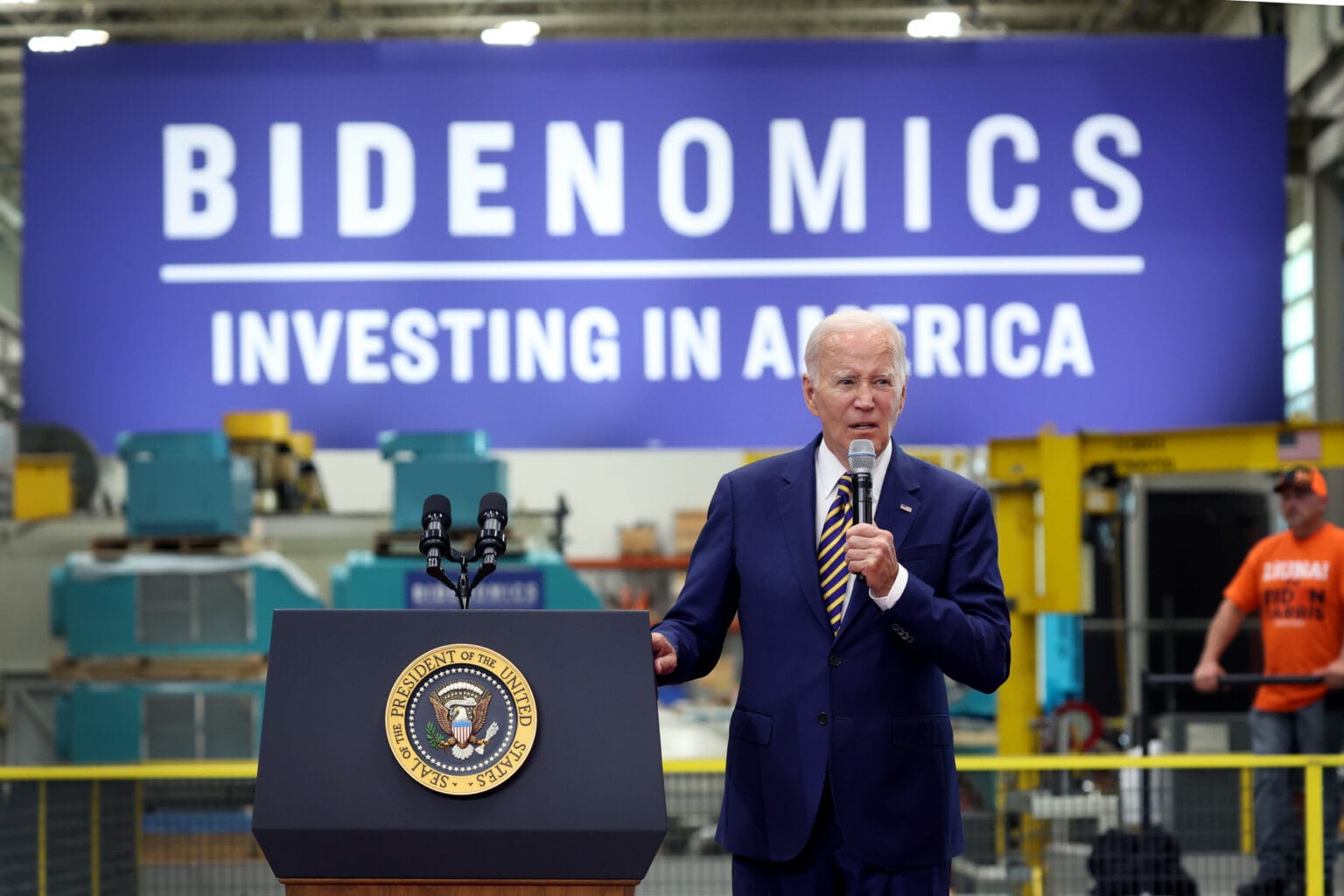
What are the two spaces? The first is political: the UN and other international fora, the G7, the G20, the WTO. China will be increasingly active there. But China also has the economy and the industries that will power the clean-tech transition, and that is something the US is struggling to build. The Biden administration tried to build up a green industry with the Inflation Reduction Act, with mixed results. Other than Tesla, name one globally competitive US clean-tech company. It’s hard. I can give you fifteen from the Chinese side.
So the key point is that China has both economic and political weight. I think it will become more active on both fronts, and each will reinforce the other.
Adrienne Buller: We’ll take a couple of questions at once now. Yes, in red.
Audience member: I’ve been thinking about what happened in Venezuela over the last year or so, where the US went to war on spurious grounds and took the oil because it felt like it. It made me wonder what’s going to happen to Latin America. When the US goes to war, it seems to push Latin America down. But then you see Brazil and other countries working with China. China seems to have more of a Soviet-style approach: we’d like to collaborate and partner with you rather than invade you, and we have something attractive and tangible to offer. Which direction do you see that going in?
Audience member: My question is also about Latin America and resource-rich countries. I’m Ecuadorian, and my [inaudible] was China. On the flip side, we’ve talked a lot about climate, rights and deployment, but China is also an investor in raw material extraction for this [inaudible].
Tim Sahay: China’s relationship with Latin America is really different from America’s. The Chinese are basically taking rocks and crops out of Latin America. Every country in the region is either a mine or a plantation, feeding the pigs in China: Chinese people love pork, and the pigs need soybeans from Argentina and Brazil. So the relationship directly empowers the latifundia class, the plantation class, the landlord class, the mining class, which is exactly the political base of the reactionary coalition. That’s why every Latin American country is split 50-50. Every election is between some crazy fascist and some Greens doing ecological Marxism, or whatever they’re doing. And you wonder what is going on. The relationship with China is absolutely critical to boosting the political power of the plantation class.
So I don’t see that changing. At this point, Lula is looking like he might lose this election. Every country will just flip 50-50 at each election, and there will be no stability unless Latin American countries form a new relationship with China. That relationship can’t be based on resource extraction; it has to actually [reduce] the power of the latifundia class and increase the power of workers.
Workers’ parties are supposed to be about industry, cities, research and universities. That’s what they need to be doing. And there’s hope that this green industrial boom, these green relationships with China, will now shift from resources to industry, empowering the workers’ parties of Latin America. That’s the hopeful picture.
But against that picture, you have the Americans starting a new Monroe Doctrine in Latin America, which says directly: if you don’t elect one of my boys, I’m going to fuck up your country. If you’re a weak country like Venezuela, we’ll invade you and decapitate your leadership. Otherwise, we’ll put extraordinary legal, economic, and tariff pressure on you, whether you’re Mexico, Brazil, or so many other countries in Latin America.
So if the Americans are going to give up a global empire and focus on a regional hegemonic strategy, the new Monroe Doctrine, that will put an enormous amount of pressure on Latin America. Can they convince Latin American countries, so many of which are oil and gas producers, to stick with oil and gas? Or will those countries escape the pressure and move towards the ecological Marxist side?
Li Shuo: Two quick points. One is on the labour politics of green industrialisation, which will be a fascinating area to watch. What I can share is the reality in China, where you increasingly see robots making robots, not people, along the assembly line. So the conventional wisdom that manufacturing capacity creates jobs, and with them labour unions and labour politics, may increasingly not hold, given automation, AI and robotics.
The other is about China and Brazil, and it’s a very anecdotal story, which I think is actually how I opened the Phenomenal World piece I wrote. I was in Brazil last November for the climate COP in Belém, a relatively remote city in the country’s north. When I got into a car to go to the venue, one thing jumped out at me. To open the window, you had to roll it down with a handle. How many of you have done that in the last ten years? Certainly not me. I’m used to pushing a button.
What that tells you about the Brazilian auto industry is that it has every kind of automaker: American, Japanese, Korean, European. Now Chinese brands are coming in, almost all of them selling electric vehicles. Because there was so little competition, the German and American brands were very comfortable selling Brazilian consumers a car where you have to roll the window down. With Chinese competition, I don’t think that will be the case anymore. So it’s an anecdote about how China’s commercial power is interacting with Brazil, and how it may begin to change life there. I think the Brazilian consumer experience will change.
Jeremy Wallace: On the last question, about nature: China seems to care not just about the climate, but has also taken part in the global biodiversity negotiations. So I’m relatively hopeful here. China has vast, gorgeous nature, but also a vast population and vast industrial and extractive resources. The tension between those and development has always been there, and probably always will be.
But increasingly, a lot of places and a lot of people think about tourism, about appreciating these beautiful places. As Li Shuo was saying, you don’t actually need people in the factories anymore. The factories are sometimes dark: they don’t even turn the lights on, because it’s all robots. So what are people doing? They’re showing off their traditional ways of life and their beautiful nature reserves, working as tour guides, taking people mountain climbing. There’s an eco-tourism boom in China. Of course it’s about making money, and it’s still capitalist, but I do think it does more to preserve biodiversity and nature than the previous model.