Mercantilism and stabilization
Smelling the roses in the weaponized world economy
By Tim Sahay, Kate Mackenzie —
Programming note: This edition of the Dispatch is based on extended notes from the "Smelling the Roses in Beijing" podcast episode (Apple, Spotify, everywhere). In it, we discuss what Trump's Beijing visit says about how the US, and the rest of the world, is working with China. Also: Kate was on the excellent The Wire China podcast last week, and both of us had a great conversation with Dave Roberts on his Volts podcast (subscriber-only edition).
- Kate and Tim
After a decade of hostile relations, tariff wars and economic wars, chip wars – things that we have been writing about since we started the newsletter in 2022 – the US now wants stabilization and a resumption of economic relations. The key phrase of the trip featured in both countries' official statements was “strategic stability.”
"President Trump and President Xi agreed that the United States and China should build a constructive relationship of strategic stability on the basis of fairness and reciprocity.”
This visit comes after a swathe of Western presidents have met Xi in 2026, including Mark Carney from Canada, Pedro Sanchez from Spain, Keir Starmer from the UK, Emmanuel Macron from France. They all sought the same things that Trump did: more Chinese investment — especially relating to EVs — and more balanced trade (in particular, better access to China's market).
Trump took an entourage of American CEOs from finance, tech, and manufacturing, declaring that China must “open up!” — and Chinese investment in the US. Xi, in response, told the executives that “China’s door to the outside world will only open wider.”
This was a sea change in the tone of US foreign policy and US-China relations. For the last decade, Trump has been decrying Chinese investments as killing American jobs and factories. In fact, for almost 10 years, both the GOP and Democrats had an "exclude China" consensus, emphasizing harms and minimizing benefits of the relationship. The practice of blaming China for hollowing out of the US middle class and manufacturing jobs has been popular political practice for far longer than that; although it's been critiqued as both economically simplistic, and simply exculpation for ruling elites in the US itself who failed to protect labor interests and avoid harmful distributive outcomes.
Much has changed. Watch Trump's interview from Beijing on Fox News, no less, to have your head spun 180 degrees.
So, what happened?
Outcomes from the meeting included:
- Trade ties: establishing US-China boards of trade and investment to codify the truce. A good sign for a turn towards a "managed trade" framework. However, few new investment deals were announced. Trump said China put in an order to Boeing for 200 planes, but Boeing stocks fell because analysts were expecting 500.
- On chips and rare earths: some perfunctory stuff about the rare earth embargo.
- On Hormuz reopening: more perfunctory stuff about China agreeing with the US in not wanting a Hormuz tollbooth and a swift diplomatic end to the war.
- Iran arms sales: the US was seeking assurances that China would not provide arms to Iran, which Xi reportedly told Trump would not happen. [FT story]
Why is Trump so keen to normalize?
The US lost the economic war; it was brought to its knees by China’s rare earth embargo. That's what we argued in a previous dispatch and Nick Mulder effectively argued in the FT recently in an op-ed titled "The era of US dominance in economic warfare is over."
Not everyone shares this view. Here is Jigar Shah, Biden’s clean energy czar, arguing Trump is selling America out! China is near collapse!
Restrictionists vs Cooperationists
Within US elites there are competing views of how to approach China now:
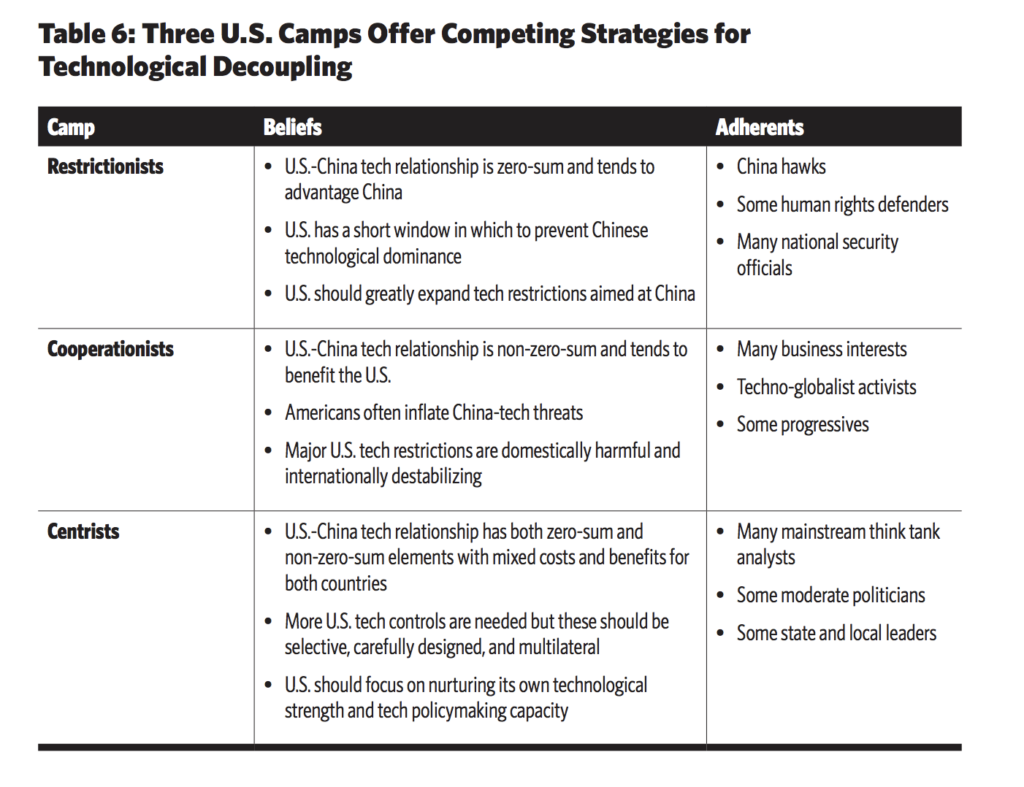
Jessica Chen Weiss argued in the FT last week that the security and restrictionists won over the last decade, the cooperationists and moderates are missing in the US and they need to be nurtured.
The China cooperationist argument: In Europe and elsewhere in 2026, you will hear the same three arguments being made by cooperationist coalitions:
- Excluding China cuts American businesses off from the Chinese market
- Excluding China restricts the motivating force of competition
- Excluding China limits American businesses’ access to the many benefits of contact with China (the gym metaphor: brutally competitive Chinese markets keep all companies operating within China lean and mean)
As Jake Werner argued, the restrictionist consensus is inflicting harm on the US economy and is often used by ruling elites to avoid blame and accountability for the consequences of their own actions.
“More than other sectors, high-value, innovation-driven products depend on the constant cross-fertilization of discussion among researchers, learning-by-doing in one business that can be applied in another one, technology transfer, symbiotic product development in research and development, or R&D, and collaborative innovation in the production process that brings output to scale. Cutting China out of US supply chains means that American businesses lose access to crucial talent, know-how, and technology, leaving them at a disadvantage in competition with the rest of the world’s leading companies.”
However there are risks:
One genuine concern is that, in reconnecting with China, American leaders might repeat their recent history of privileging business interests over those of workers, local communities, and the environment. Likewise, though Chinese firms are not scheming to destroy America, they certainly will take the easiest and most profitable path if left to their own devices. Achieving economic growth at the expense of the human beings whose activities make up the economy would be both pyrrhic and unsustainable.
Werner points out that the US has ample state capacity to manage these concerns. The questions are whether it would actually design the sophisticated industrial policy and implement close monitoring to address them.
Meanwhile, in Europe
Europe also has plenty of state capacity to deal with China in a sophisticated way that protects its own society and security. It has been more nuanced and constructive in how it engages with China over the past decade than the US.
A similar struggle to that in the US is taking place between Europe's restrictionists (France) and cooperationists (Germany). That struggle is coming to a head in Europe this year with a series of negotiations over the EU Industrial Accelerator Act, expected in late 2026, amid tariffs and antidumping duties on China, and ratcheting up of requirements for technology transfer and local content. The German Marshall Fund summarizes the IAA: "The IAA marks a clear shift in the bloc’s industrial policy from decades of open, nondiscriminatory procurement toward a more strategic use of demand to support EU innovation, production, and jobs." However, the classic EU problem looms, finding unity among member states on China is not easy.
Europe’s security concerns include Chinese spyware in batteries and cars and electrical grid gear. Fears are elevated because of Russia’s attacks on Ukraine's electricity system; and there have been 23 cyberattacks in EU energy systems since 2023.
The EU is banning solar inverters from “high-risk” countries in EU-funded projects to eliminate Chinese dependency. The European Commission has judged that inverters can be shut down remotely and pose an intolerable cybersecurity risk. So Europe will use its own competitive domestic inverter manufacturers (Spain is dominant solar inverter manufacturer, so the homegrown alternatives are cheap and easy to get), while simultaneously importing secure, low-cost components, like the solar panels from China themselves.
What are the implications for climate and development in poorer developing countries?
The direction of travel in 2026 is that the US acknowledges Chinese financial and industrial power and Europe concedes it needs to abandon its liberal hands-off formula of relations with China. And how is everyone else looking at economic relations with China?
There are two ways of looking at the implications of China stabilization for lower-middle and lower-income countries:
1) The leapfrog argument
Using China’s clean tech exports (solar and batteries in particular) to leapfrog to cleaner, secure, reliable electricity systems. Do climate and development, just buy the Chinese kit! The argument is that this is an unalloyed good because these countries cannot really compete on manufacturing of most electric technologies. But they can buy, install, and modernize their whole economies with cheap electricity that has held many back. As for security concerns, Chinese companies already dominate telecoms in much of the continent.
2) The China Squeeze argument
China poses an enormous challenge to the standard development models. Low-wage, assembly manufacturing jobs were once the entry ticket to structural transformation and growth. But China has slammed that door by not just doing high-tech which challenges the rich advanced manufacturing countries in Europe and East Asia (esp. Germany, Korea, Japan, the US) but by also not giving up on its low-tech, low wage, labor-intensive jobs.
In short, not the China Shock, but what a PIIE paper by Shoumitro Chatterjee and Arvind Subramanian calls the "China Squeeze" for developing countries.
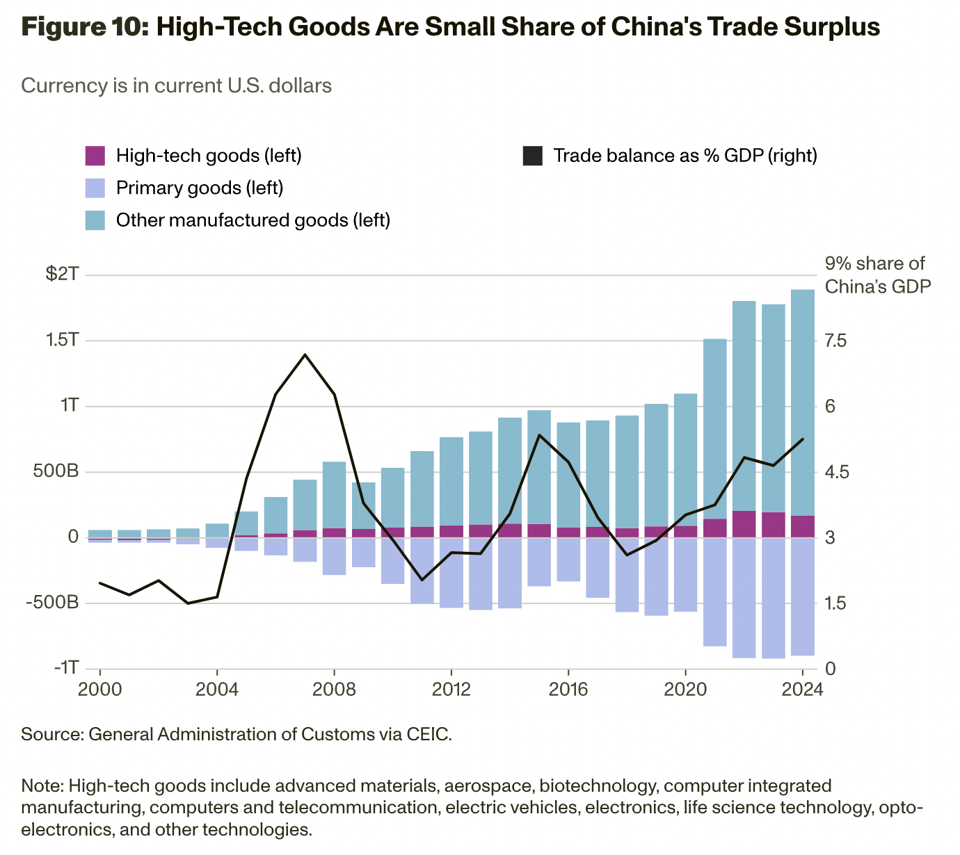
The puzzle: not why China is so competitive in EVs, solar panels, batteries and high-tech goods (aka China Shock 2.0) — but why does it continue to dominate labor-intensive exports?
"We quantify China’s excess exports in 2 ways. Relative to: its labor endowment & Rich countries’ exports at comparable development stage. Both yield magnitudes in hundreds of billions of $ in foregone poor country exports and foreclosing of their industrialisation potential"
Will the China Squeeze last?
Here are two potential routes out of the China Squeeze:
More outward FDI from China? Almost certainly — but which countries will benefit? Those with bargaining power in the form of attractive consumer markets (Brazil, etc.) , or with resources (Indonesia etc.), or with free trade agreements with the West (Morocco, Oman etc.). Those that do best with manufacturing FDI are countries with strong state capabilities and counterbalancing developmentalist coalitions and sheer political agility.
More consumption inside China, thus becoming more of an import market for other countries? No one is counting on a shift away from the investment-heavy, surplus-focused, export-oriented economic model.
Why the roses in the title?
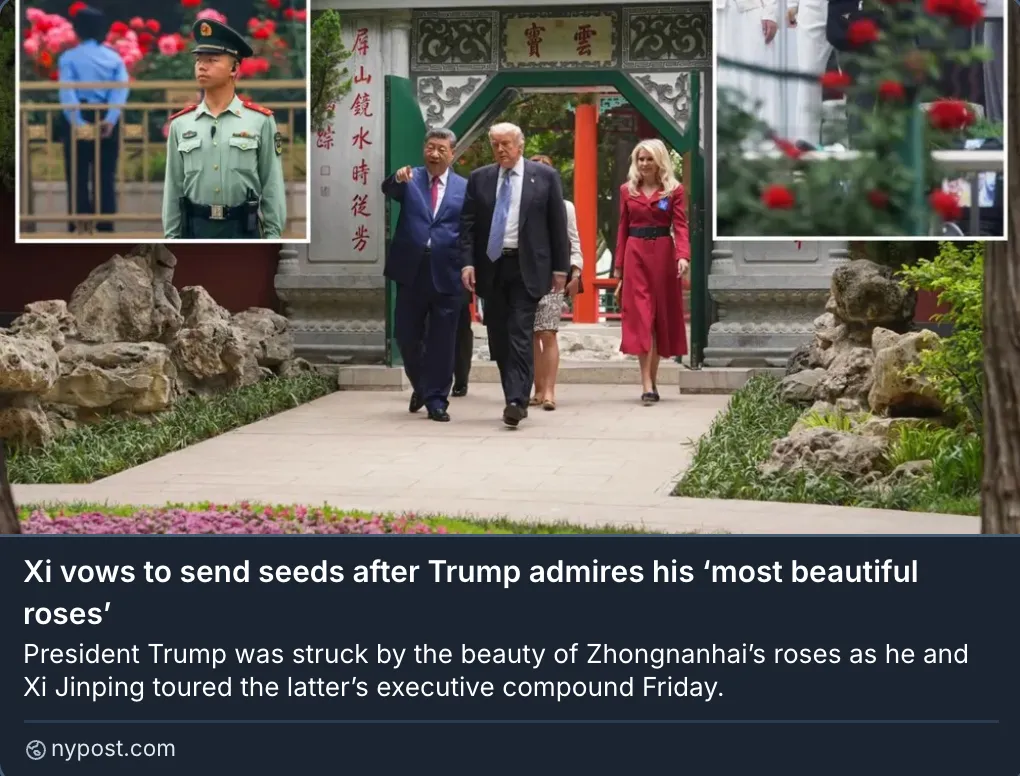
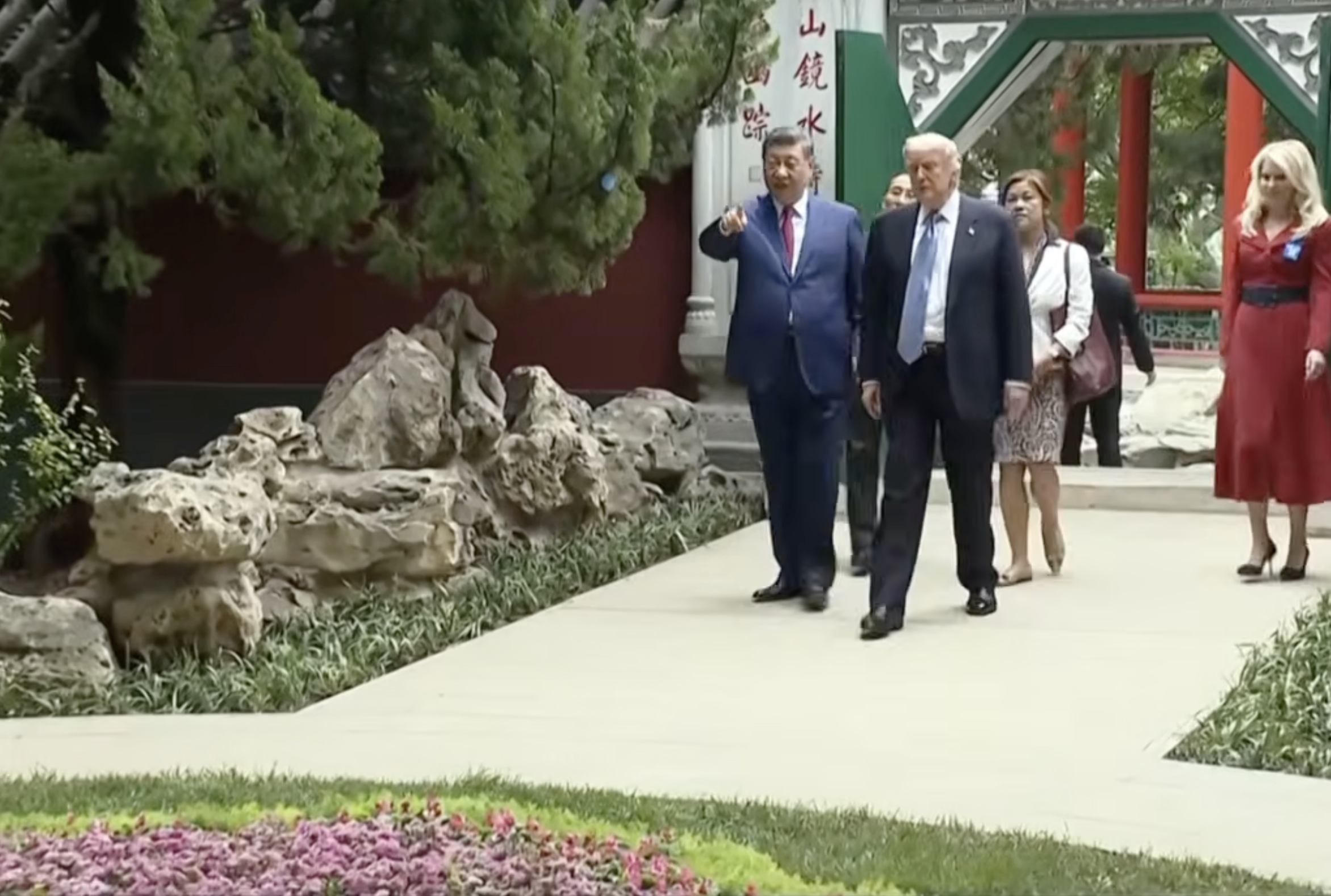
Tim is tickled by the absolute scenes of Xi taking Trump to visit the (former) imperial rose garden of Beijing. After Trump destroyed the rose garden in the White House, this is a metaphor for the self-harm that he is doing to the American position in the world. Now Trump tells Xi he wants these roses plucked from within the headquarters of the Communist Party of China to be sent to him at the White House! [source]
That's it for this week; we're taking a break next week but will be back in early June.