Gulf drama kings | Demand Destruction | 02
Oil or geopolitics; same same
By Tim Sahay, Kate Mackenzie —
The UAE's announcement that it will quit OPEC and OPEC+ briefly eclipsed news of the war last week. The UAE is the most powerful member of the cartel after Saudi Arabia, so its exit prompted the question of whether OPEC was doomed after this; and how much it reflected broader geopolitical tensions between two countries versus just differences over actual OPEC policy; and how much the war has exacerbated any of this.
That's the topic of our latest podcast episode [Spotify, Apple, everywhere] in the bonus season.
- The oil story
Cartels exist to coordinate behaviour and, in OPEC's case, to ensure that a big chunk of the world's oil producers don't pump out so much that the prices crash, destroying their main source of revenue. (The flip side is that they also don't want prices to go so high that it pushes the world away from using oil, which happened in the 1970s and early 1980s – this is particularly a concern for Saudi Arabia.)
OPEC's influence on oil prices was weakened by the rise of US shale oil production in the early 2010s; and in the past few years the UAE has been pushing back on quota restrictions from OPEC, arguing that its quota doesn't reflect its actual capacity which its invested in.
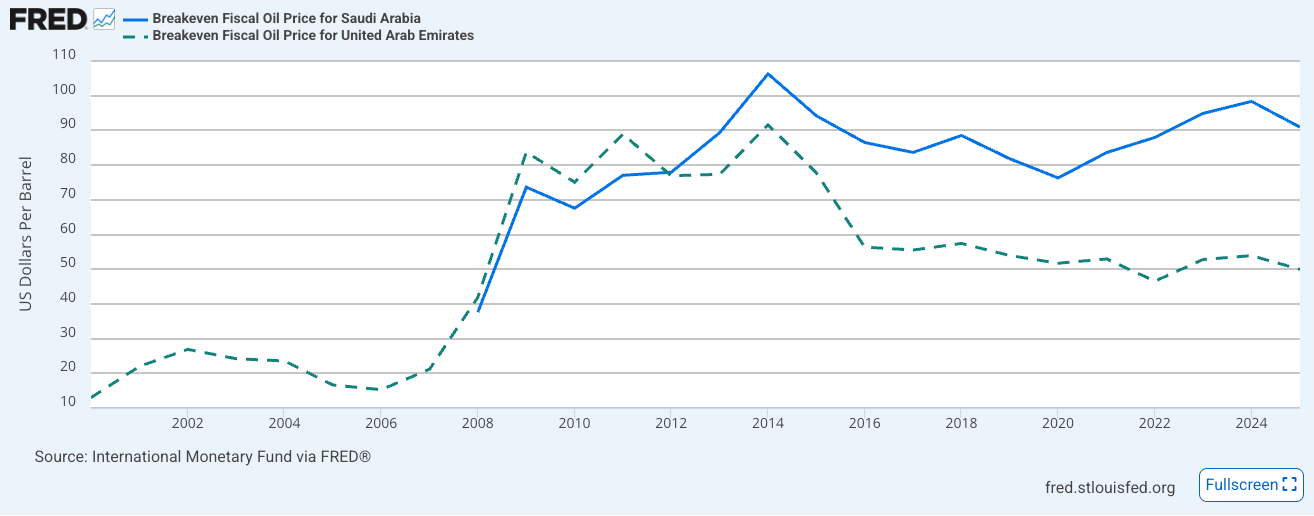
There's a bigger strategic divergence, too: the UAE simply doesn't care so much for trying to keep the price of oil high by pumping less; it would rather just sell as much as it can today. The underlying differences are that the UAE has a smaller population relative to its oil revenues; and Saudi Arabia has been less successful at diversifying its economy away from oil rents.
The UAE can live with a much, much lower price per barrel:
We talked about whether the different strategies reflect different beliefs about the outlook for oil. Is the UAE leadership assuming that demand for its most important export is disappearing, while Saudi Arabia is more optimistic? Or is Saudi Arabia is just responding with different tactics because it has to? The famous quote that "the Stone Age didn't end because we ran out of stones, and the oil age won't end because we run out of oil", which is often attributed to former Saudi oil minister Ahmad Zaki Yamani, is one sign of wariness about taking oil demand for granted. So the Saudi Arabian strategy is probably a pragmatic one, given that a higher price is more important.
- The geopolitics
Tim points out in the podcast that the war has exacerbated tensions between the two kingdoms.
The UAE is being targeted by Iranian missiles and drones almost as much as Israel; and its top diplomatic advisor had complained of the lack of solidarity at a Gulf Cooperation Council meeting just the day before the OPEC announcement. Remember, Saudi Arabia's stance towards Iran has recently been one of rapprochment. Regional and personal rivalries come into it, as does the fact that the UAE has become closer to the US through its investments there (including a great deal in AI) and simply through having built itself into an international finance, tourism and transport hub.
Shownotes: Two of the key archival stories we referenced in the podcast:
Mohammed bin Zayed’s Dark Vision of the Middle East’s Future - The New York Times - NYT, September 2020
How Midnight OPEC Dealmaking Won Gulf Unity at Africa’s Expense - Bloomberg, June 2023