Eulogies for the rules-based international order have been piling up in 2026. Mark Carney’s speech at Davos in January was lauded for its open acknowledgment of the political “rupture” in the world order that has been long apparent, but which no world leader of the global North had as yet been willing to openly name. The US-led liberal order was as good as finished, Carney surmised, and it was incumbent on “middle powers” such as Canada and the Europeans to recognize that fact. In its place, “a system of intensifying great power rivalry where the most powerful pursue their interests using economic integration as a weapon of coercion” was emerging. He described a near-Hobbesian vision of geopolitical relations in which “the strong can do what they can and the weak must suffer what they must.” The task, he argued, was for middle powers to “act together” so as to increase their leverage. “If we’re not at the table,” he warned, “we’re on the menu.”
Carney’s speech was received at the time as not only a clarion call for what Finnish president Alexander Stubbs has called “values-based realism,” but as a viable alternative to the bullying treatment many US allies have received at the hands of the second Trump administration. The joint Israeli and US airstrikes on Iran last week brought with them the first test of Carney’s stated commitment to “sovereignty and territorial integrity,” as he had put it in his speech at Davos, and Carney was quick to voiced his support for his allies’ bombing campaign in the name of “international peace and security”—all while insisting the assault was due to the “failure of the rules-based international order.” Whether or not Canada will be drawn into the expanding war in the Middle East remains to be seen. For now, Carney is plowing ahead with his plans for building strategic autonomy from Washington’s unpredictable trade policies. This week, he made visits to Japan, India, and Australia in an effort to boost trade around and without the US.
Canadian pivot
Mark Carney’s political career is in some ways a product of Trump’s second term. It was to large extent the popular revulsion among Canadians against the Trump administration that helped secure the Liberal Party’s surprising election win last April. Once in government, Carney set out to forge a domestic coalition that would commit to breaking the country’s dependence on the US, which currently accounts for three-quarters of its export revenue. In its first six months, it made twelve new trade deals.
It was in advance of the WEF summit at Davos that Carney made his five-day state visit to Beijing, seeking to reset relations with China and, in the process, diversify away from the US. He came away with a series of trade and investment deals, including a significant deal for the Canadian import of Chinese electric vehicles. Preliminary plans for joint ventures with Chinese EV companies were also floated. In exchange, China agreed to drop its punitive barriers on Canadian canola and other agricultural exports. Beijing dropped all visa requirements for Canadian tourists, and both countries made it easier for researchers to travel.
The deal on EVs is significant. China now has a foothold on the North American continent. Chinese cars had suffered a 100 percent tariff since 2024, when Ontario was moving in lockstep with the Biden administration. The new deal will allow the import of just 49,000 tariff-free EVs a year, rising to 70,000 cars by 2030, which is a tiny fraction of Canada’s 1.8 million car sales annually. Nevertheless, Carney’s new strategy marks a significant shift, and the recognition that the Canadian auto industry can no longer remain shackled to an American regime of internal combustion engines. It’s for this reason that Carney is selling the new deal with China as an “opportunity” for Ontario car makers, allowing foreign automakers to set up factories and battery plants in Canada.
Last year, Carney thawed a decade-long chill between his federal Liberal government and the country’s politically-powerful oil industry by rolling back restrictions on a new oil pipeline. A recently built east-to-west pipeline has already increased oil sales to China dramatically since 2023. This in turn has helped to ameliorate the threat of the US swapping its own Canadian crude imports for Venezuelan. There is even talk of China investing in the hypothetical new pipeline to British Colombia. That seems highly unlikely, but in the meantime, Alberta takes comfort that Chinese refiners are importing more Canadian crude – and countries are now calling on Canada as energy disruptions surge from the middle eastern war.
As is the case with much of the North Atlantic, Canada is dramatically increasing its military spending, which will hit 2 percent of GDP this year and as high as 5 percent of GDP by 2035. It’s also looking outwards. In December it became the first foreign partner to Europe’s SAFE fund, which provides €150bn of loans for member countries to boost their defense budgets by 2030, giving Canadian companies superior access to huge amounts of European military spending. It’s seeking similar collaborations in the Asia-Pacific, particularly with Australia, New Zealand, Japan, and South Korea.
Courting Beijing
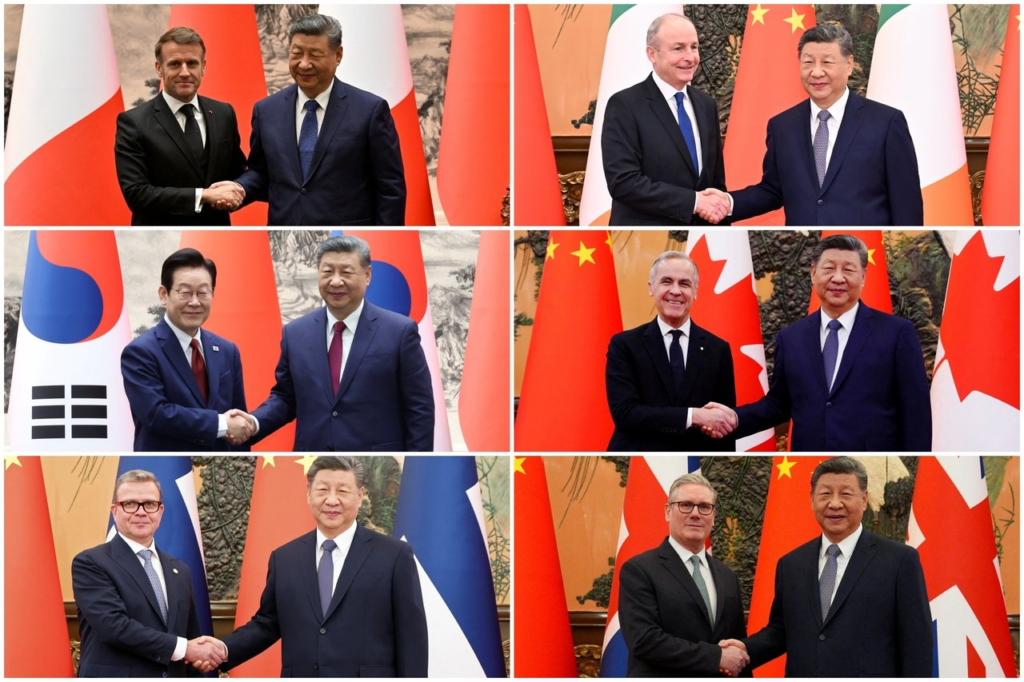
Carney is not the only Western leader to seeking meetings in Beijing with Xi Jinping and laying the groundwork for new trade deals in a bid to defend against US tariffs.
In December, French President Emmanuel Macron travelled to Beijing seeking, among other things, to shore up a possible purchase of 500 Airbus planes. In January, a trip from Ireland’s president Micheál Martin won concessions on his country’s beef exports to China. On his heels, Keir Starmer’s visit signalled the end of frosty diplomatic relations between London and Beijing, and the start of something more reciprocal.
Spanish prime minister Pedro Sanchez is scheduled to make his fourth visit to Beijing in April and is strengthening trade and economic ties with China, particularly in EVs and green investments, at the same time as he is reducing Spain’s dependency on US tech giants. He is the only European leader who has been able to unequivocally condemn the attacks on Iran.
Japan is perhaps an outlier. Its new prime minister Sanae Takaichi won a supermajority in February’s elections after Chinese efforts to discipline Japan over Taiwan backfired. Takachi has already shown herself a loyal ally to Trump and she has promised to revoke Japan’s pacifist Article 9 and ramp up military spending. Under Takachi’s new military plan, Japan is set to become the world’s third largest defense spender, after the US and China.
Warming relations with China hasn’t stopped the EU from going on an enormous remilitarization drive. NATO member states are complying with Trump’s spending target of 5 percent of GDP, which for most of them means more than doubling their defense spending. Differences between member states and their respective companies are a barrier to full realization of the bloc’s potential. Dassault, a family-controlled French company that makes fighter jets, is reportedly dictating terms of a Franco-German collaboration on a new European fighter jet programme, the €100 billion Future Combat Air system. European industries may benefit from industrial policy measures that the EU had previously foresworn, like local procurement rules. Its Industrial Accelerator Act proposes Made-in-Europe procurement for the bloc’s $2 trillion annual public spend, along with tech transfer requirements, and 51-49 joint ventures for inbound foreign direct investment. There are signs that this surge of domestic oriented fiscal outlay are beginning to work: European remilitarization is starting to drive industrial growth. Europe has entered its Metal Era.

Non-Hegemony
Is a meaningful breakaway from the US-led order possible? US economic pressure is more effective against allies than adversaries, as the historian Nicholas Mulder has argued. Allies of Washington have deep trade, finance, and security linkages with the US that have made them more vulnerable to the Trumpian geo-economics. Adversaries, by contrast, have long worked to make themselves more resilient against American coercion.
For its part, the US is demanding extravagant financial commitments from large countries who want to avoid being locked out of the lucrative US consumer market by sky-high tariffs. Many of the US’s traditional allies reacted first with appeasement and delay, pledging massive foreign direct investment into US (Japan), to spend four times their typical annual outlay on gas imports (Europe), and to quadruple their existing US imports (India).
Countries failing to deliver on their promises to the Mafiosa hegemon might be punished, but when and for how long? The TACO label (“Trump Always Chickens Out”) levelled at the president for his failure to execute some of his more absurd declarations probably also applies here. We call the international equivalent EMPANADA: “Everyone Makes Promises And No-one Actually Does Anything” Countries that do this are trying to buy time reactively, rather than the more proactive strategic approach of Canada.
As dangerous as the current situation is to many traditional allies of the US, there are clear obstacles to walking away. Key among these is the singular power of the $20 trillion US consumer market for goods and services.
Canada is extraordinarily dependent on this huge market to its south, but it is hardly alone in this condition. The situation is particularly acute for those countries that lack complex industries. In Lesotho, for example, 10 percent of GDP comes from garments exported to the US. Bigger, wealthier and more diversified countries can make deals among themselves, and are “speed dating” in their efforts to substitute for the US—as one sees with Carney’s latest tour. With East Asia and Europe running surpluses, the US consumer market remains the largest source of demand for goods and services, a buyer of last resort.

The African Growth and Opportunity Act 2000 reduced zero tariffs on thousands of items for 32 African countries and created an estimated 300,000 jobs directly and another 1.3 million indirectly. It was allowed to expire in September 2025, although in February the administration and Congress agreed to extend it to 2028. In the short term, though, the extension is of limited help; the think tank ODI says the uncertainty has already hurt investment in Lesotho and Madagascar.

The already-unfolding world of middle-power pragmatism has little to say about, let alone offer to, the smaller and poorer countries which stand to lose the “minimal degree of cohesion and stability” that was provided under the previous US-led order. Many of the development aid budgets available to most of these countries have been cut in the past year, and finance for climate-vulnerable countries remains paltry. Those in Gaza, acutely aware of the failures of the rules-based international order long before the return of Trump, can expect diminishing global attention.
Questions of security, energy, trade and industrial strategy will roil political electorates in powerful countries. The degree to which those countries can find a domestic base will also determine their efforts to build any real post-US multilateral order that goes beyond safeguarding their own survival. The shape of the post-American world will be determined in part by the commitment and durability of Trump’s tariff war.
Carney’s logic is that Trumpism is a paper tiger. His judgment is that the US cannot actually withstand pain and punishment from the blowback from its economic war on the world because American society is polarized, has a threadbare safety net and its elites lack popular legitimacy. It is American consumers and importers who are absorbing 90 percent of the cost from tariffs not foreigners, according to Federal Reserve research. Trump will likely face a brutal reckoning in the November midterm elections.
For now, the new reordering of trade and diplomatic relations appears set to stumble onwards, as US allies reach out to Beijing and beyond in an attempt to insulate themselves against Trump. As American bombs continue to rain down on Iranian, and now Lebanese, cities and towns, the security alliance, however, appears to remain intact.