

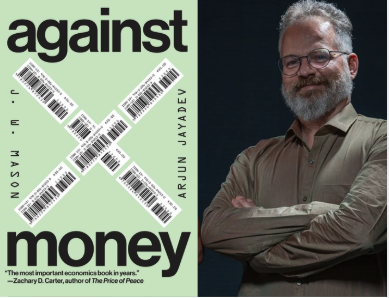
Our first 2026 book club is: Against Money with JW Mason! (There is a small chance Arjun Jayadev will also join us, travel times permitting).
It's 4pm EST Monday, June 29. (Convert to your local time zone)
You’ll need to pre-register for this one.
To whet your appetite, here is Mona Ali's review; and Jon Sindreau’s in Reuters.
Below is an excerpt from JW Mason's blogpost introducing Against Money's core idea as the difference between the world of money with its own internal logic, and the world of productive activity that it interacts with — but is conceptually, historically and politically distinct from.
"....When we think of money as neutral, that implies a specific kind of views about social reality in general. If we think of money as a transparent window onto a pre-existing world of goods, a pre-existing set of relative values, a pre-existing set of opportunities and resources facing us, then we are going to see the world itself as fundamentally money-like. We are going to see the existence of prices, the division of social reality into discrete commodities with ownership rights attached to them, as a basic fact about the world, which money is simply revealing to us.
When we see money as a distinct institution, as a distinct social technology of coordination, then we can see the rest of the world as being different from that. We can see all the ways in which the process of production, all the ways we organize our society are different from what happens in markets and different from what is mediated by money. We can see the world not as a set of existing commodities that need to be allocated to their best use to satisfy human needs but as an open-ended collective project of transforming the material world.
This second view is what Keynes called the monetary production paradigm.
In the 1932 article that I earlier suggested could mark the beginning of the Keynesian revolution, Keynes distinguished a real exchange view of the economy from a monetary production view. The real exchange view he associated with the traditional view of money as neutral — it’s a vision of a world in which fundamentally the economic problem is barter. So for instance Paul Samuelson’s famous textbook, the most influential economics textbook of the 20th century, says that we can reduce essentially all economic problems to problems of barter.
In this world, the economic process is fundamentally about exchanging real things. Production is just a special case of exchange. You put in your capital, I put in my labor, we get a definite amount of output out that we divide in proportion to what we put in, on terms that we all knew and agreed on in advance.
The real exchange view of production was perfectly expressed by Keynes’ Swedish contemporary Knut Wicksell, the originator of the modern approach to monetary policy. He described economic growth as being like wine aging in barrels. We’d like to drink the wine today, because that would be nice; but on the other hand if we leave it to age in the barrel for longer it will improve in quality. The wine is already there, we know how much there is and how much better it will be next year. All the possibilities are defined in advance. We just have to decide what pace of drinking it will bring us the most pleasure.
A monetary production view of the world, on the other hand, is one in which the economic process is a one of collectively transforming the world. This is an active process that structured and mediated by money, and organized around the accumulation of money. In this view of the world, production is a cooperative human activity whose possibilities are not knowable in advance.
In this monetary-production paradigm, the fundamental constraint is not scarcity; the economic problem is not allocation. The fundamental constraint is coordination. When we stop imagining the world in terms of discrete commodities being combined in different ways, and start imagining it in terms of human beings cooperating (or not) to do things together, the problem becomes: How do we coordinate the activity of all these different people? What does it take to allow cooperation on a larger scale, between people who don’t have pre-existing relationships?
That is the problem that economic life is seeking to solve. And in particular, we argue, it is the problem that money helps solve. By its nature, this is not a problem that we can know where the opportunities are in advance. This uncertainty about the possibilities of the future is a fundamental component of Keynes’ vision, and is linked to the centrality that money has in his vision."